
Who Are We Protecting?
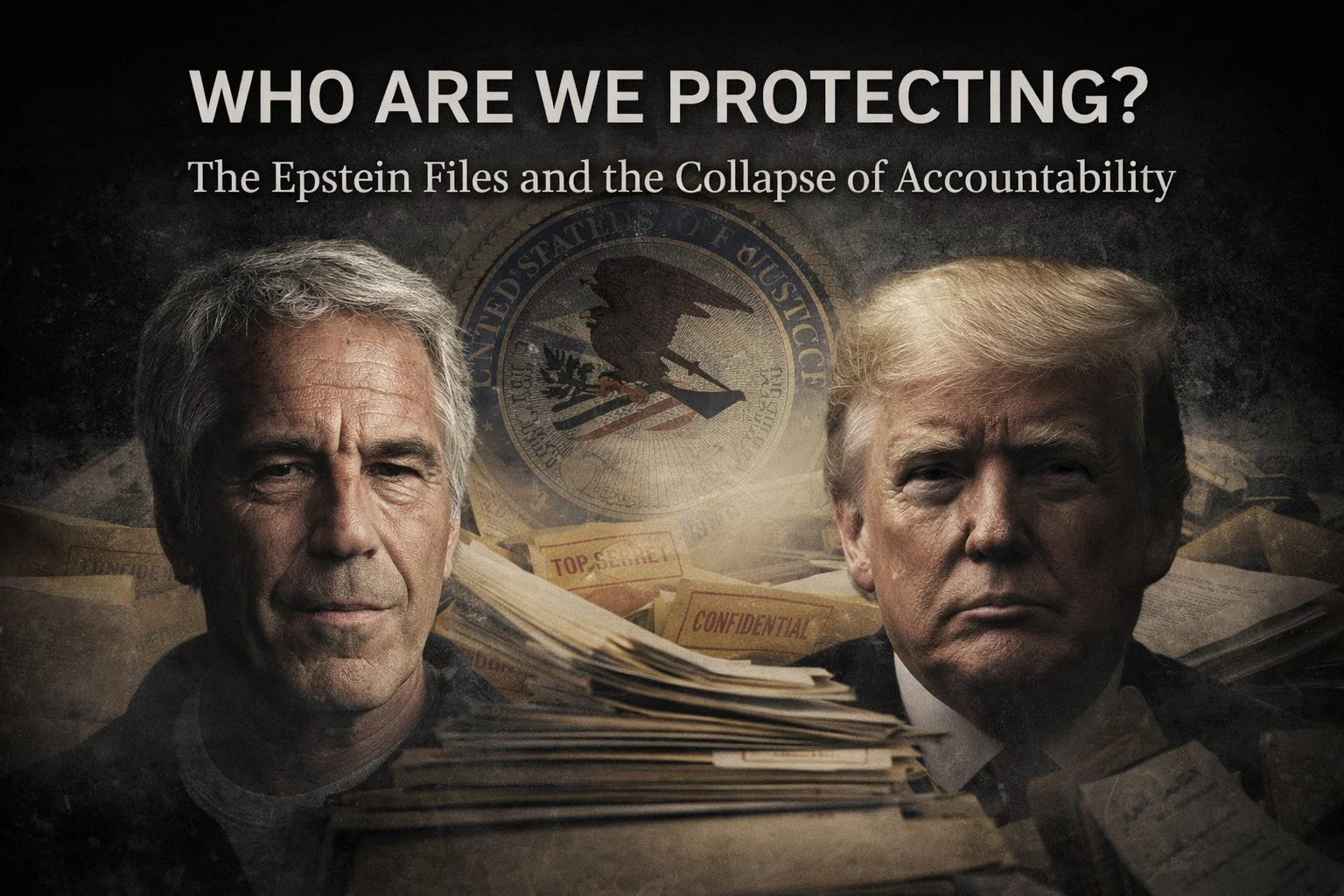
The Epstein Files and the Collapse of Accountability
According to an analysis by the New York Times, the January 2026 release of Jeffrey Epstein documents contains more than 5,300 files with over 38,000 references to Donald Trump, his wife, or Trump-owned properties, including Mar-a-Lago. The Times noted that these references vary widely in significance and do not, on their own, establish criminal conduct.
But the sheer volume of material raises a more troubling issue—one that goes well beyond any single name.
The release is partial by design. The Department of Justice has acknowledged that thousands of additional Epstein-related files exist, yet says it will not release them, arguing that further disclosure is not legally required. At the same time, DOJ officials have announced they do not intend to seek new prosecutions connected to Epstein’s sex-trafficking operation.
The public is left with an unavoidable question: why?
What, exactly, is contained in the files the government refuses to release? And who is being protected by that decision?
The Epstein materials already made public name or reference some of the most powerful and well-connected people in the world—politicians, business leaders, royalty, and cultural elites. The Justice Department insists that withholding the remaining files is consistent with the law. But legality is not the same as legitimacy, and compliance is not the same as justice.
The contradiction is stark.
Hundreds of women have come forward as survivors of Epstein’s trafficking network. Attorneys representing victims say they have worked with more than 200 survivors, many of whom were underage at the time of the abuse. Credible reporting has long established that Epstein systematically recruited and exploited teenage girls, some as young as 14, through a coordinated operation that could not have functioned without help—or at least willful indifference—by others.
And yet, the government now says there is insufficient evidence to bring charges against a single additional person.
Not one.
How does a system arrive at that conclusion? How can an operation that produced hundreds of victims, generated settlements, convictions, sealed agreements, and mountains of documentation somehow produce no prosecutable conduct beyond one dead trafficker and one convicted accomplice?
Transparency without accountability is not justice. It is theater.
A government that can catalog abuse at industrial scale, but declines to test that evidence in court, invites the public to draw its own conclusions. When files are released selectively, prosecutions are ruled out preemptively, and survivors are left with silence instead of answers, the message is unmistakable: some truths are considered too dangerous to fully expose.
Democracies do not collapse only when laws are broken. They erode when power decides which questions are allowed to be asked—and which will never be answered.