
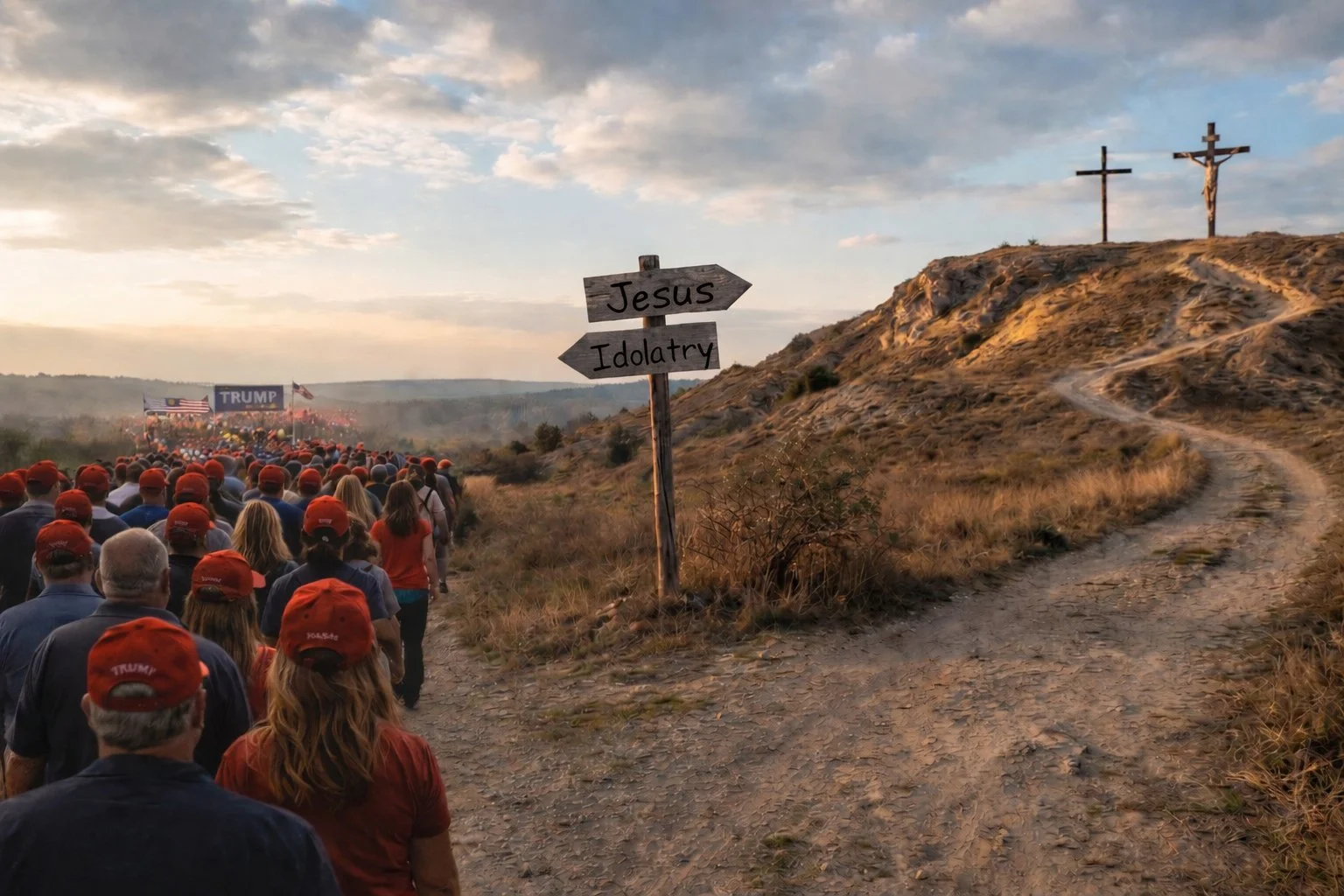
Christians: Why Are You Still Defending Donald Trump?
For generations, evangelical Christians in America preached a simple truth:
Character matters. Integrity matters. Truth matters. Humility matters.
We taught our children that leaders should be held to a higher standard — not excused from one.
So a hard question must be asked:
Why have so many Christians abandoned those principles for Donald Trump?
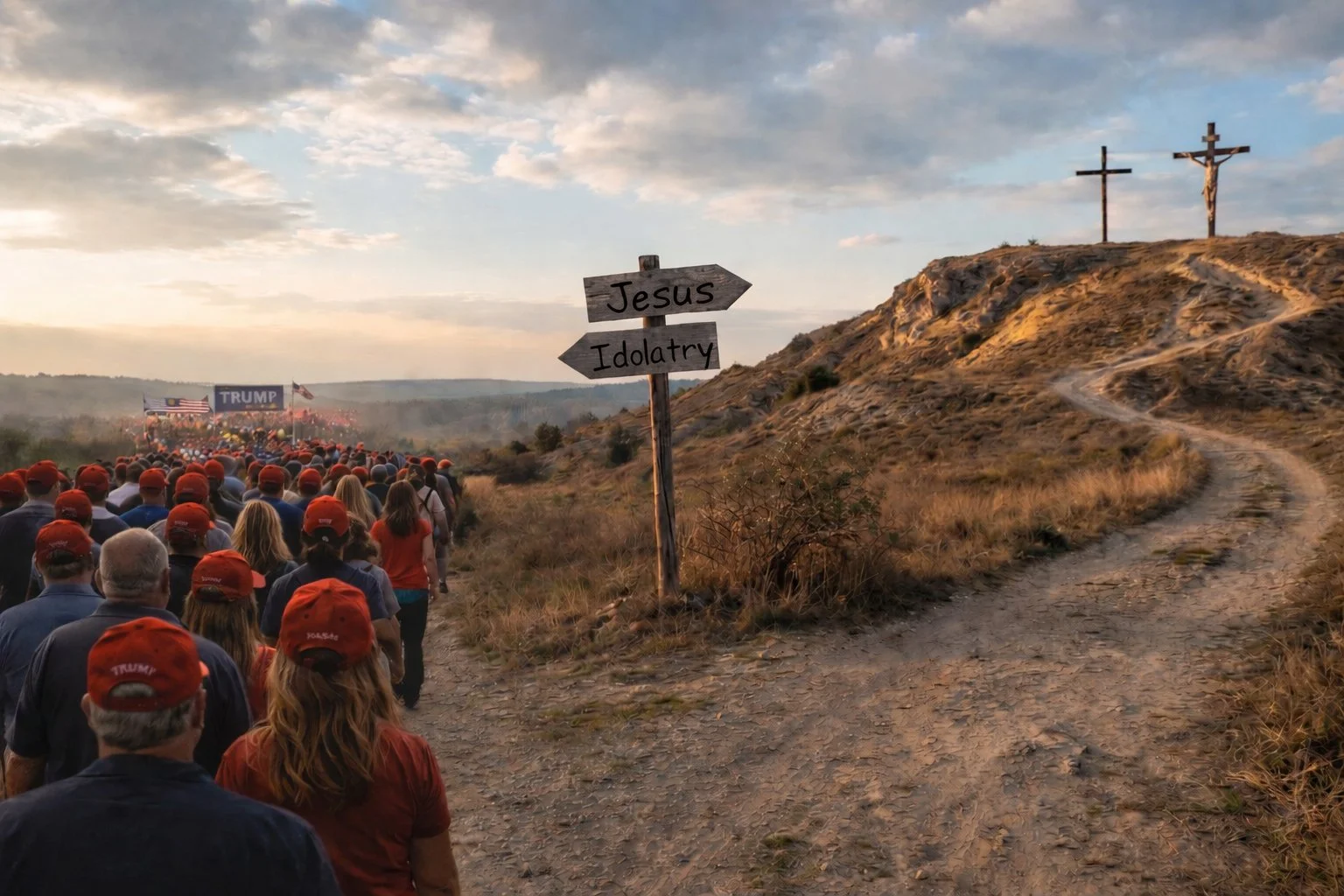
At some point, a choice is made. Following Jesus and worshiping power are not the same road.
For generations, evangelical Christians in America preached a simple truth:
Character matters. Integrity matters. Truth matters. Humility matters.
We taught our children that leaders should be held to a higher standard — not excused from one.
So a hard question must be asked:
Why have so many Christians abandoned those principles for Donald Trump?
Not quietly.
Not reluctantly.
But loudly. Defensively. Repeatedly.
Even when his behavior directly contradicts the teachings of Jesus.
•Donald Trump has mocked the disabled.
•Boasted about sexual assault.
•Committed public adultery and paid hush money.
•Used blatant racist language and imagery.
•Belittled prisoners of war.
•Mocked the dead and the grieving.
•Spread constant lies.
•Fueled anger and division.
•Enriched himself through office.
•Excused brutality.
•Protected powerful men instead of victims.
•Refused transparency when truth was owed.
None of this reflects Christ.
Not one part of it.
And yet millions of Christians defend it.
Because he is “on their side.”
This is not faith.
It is tribalism.
It is loyalty to power.
It is moral surrender.
Yes, Scripture tells us God uses flawed people.
But Scripture never tells us to celebrate corruption.
Never tells us to excuse cruelty.
Never tells us to defend lies.
Never tells us to trade truth for political advantage.
David repented.
Peter wept.
Paul changed.
Donald Trump brags.
He never repents.
He never apologizes.
He never shows humility.
He never asks forgiveness.
There is no evidence in his public life that he follows Jesus.
There is overwhelming evidence that he uses Christians.
Trump and the media outlets that promote him have built a false spiritual narrative — a manufactured “holy war” — where political opponents are treated as enemies of God.
This is dangerous.
It is spiritual manipulation.
It turns faith into a weapon.
It turns politics into a religion.
It turns Christians into foot soldiers for a man who does not share their values.
Jesus warned about false prophets.
About wolves in sheep’s clothing.
About those who would use religion for power.
The Bible did not warn us about kind, humble servants.
It warned us about proud, deceptive men who would flatter believers for influence.
Ask yourself honestly:
If Donald Trump were applying to be your church’s youth pastor, would you hire him?
If he were dating your daughter, would you approve?
If he were leading your Bible study, would you trust him?
If the answer is no, why is he acceptable as the moral representative of millions of Christians?
When Christians excuse cruelty, they teach cruelty.
When Christians excuse dishonesty, they normalize dishonesty.
When Christians excuse abuse, they enable abuse.
When Christians excuse authoritarianism, they help destroy democracy.
And when Christians defend a man who thrives on hate, lies, and division, they betray the teachings of Christ.
Jesus taught humility.
Trump teaches domination.
Jesus taught truth.
Trump traffics in lies.
Jesus taught love of neighbor.
Trump fuels resentment.
Jesus taught service.
Trump worships himself.
These are opposites.
Not differences.
Opposites.
This is not about Democrats vs Republicans.
It is about Christ vs power.
It is about conscience vs tribe.
It is about whether the Church still believes what it preaches.
History will remember this season.
It will remember whether Christians stood for truth…
or surrendered it for influence.
You still have a choice.
You can stop pretending this is righteous.
You can stop calling corruption “God’s will.”
You can stop confusing political loyalty with faith.
You can choose Christ over Trump.
Because once faith becomes a tool of propaganda, it stops being faith at all.
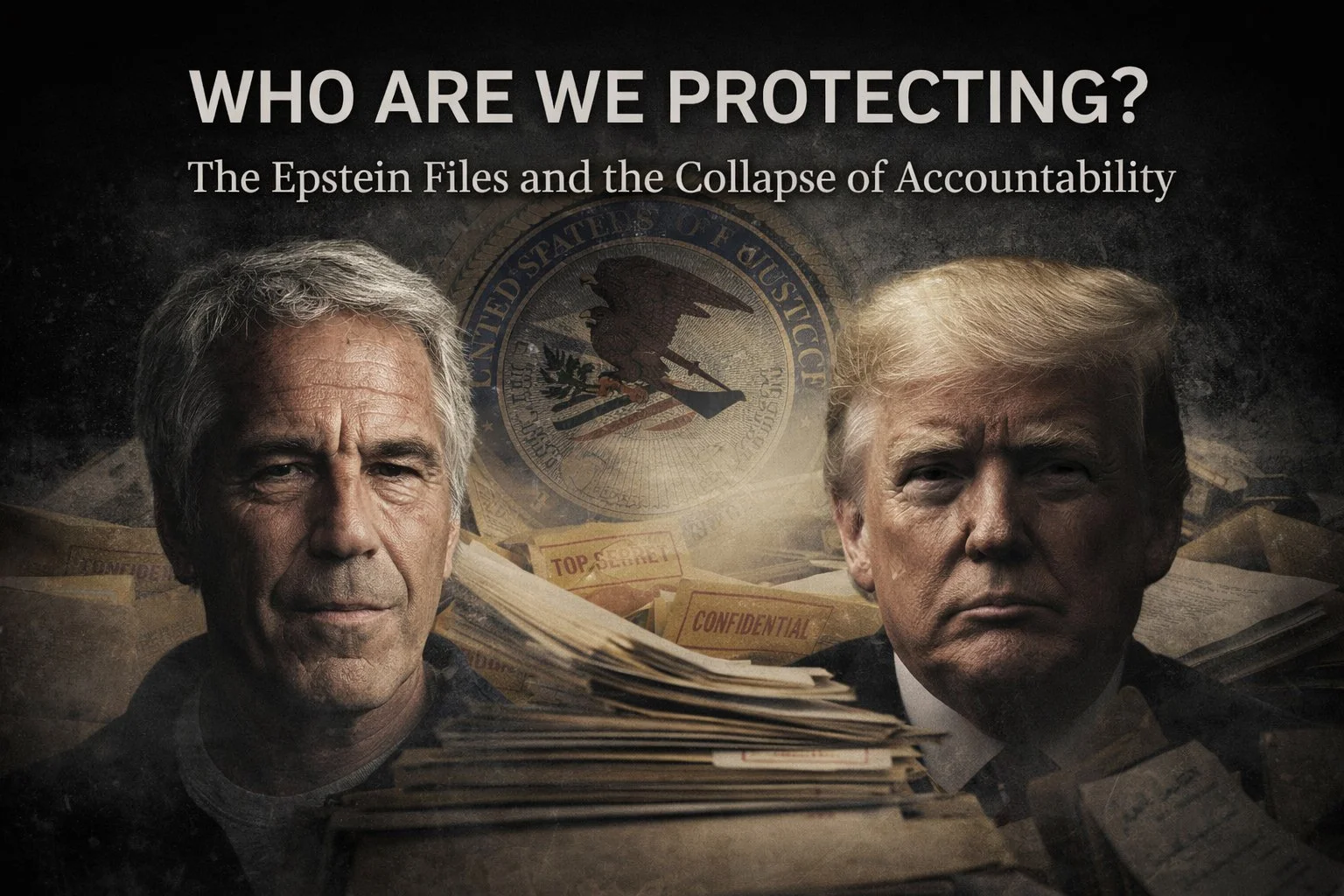
Who Are We Protecting?
According to an analysis by the New York Times, the January 2026 release of Jeffrey Epstein documents contains more than 5,300 files with over 38,000 references to Donald Trump, his wife, or Trump-owned properties, including Mar-a-Lago. The Times noted that these references vary widely in significance and do not, on their own, establish criminal conduct.
But the sheer volume of material raises a more troubling issue—one that goes well beyond any single name.
The release is partial by design. The Department of Justice has acknowledged that thousands of additional Epstein-related files exist, yet says it will not release them, arguing that further disclosure is not legally required. At the same time, DOJ officials have announced they do not intend to seek new prosecutions connected to Epstein’s sex-trafficking operation.
The public is left with an unavoidable question: why?
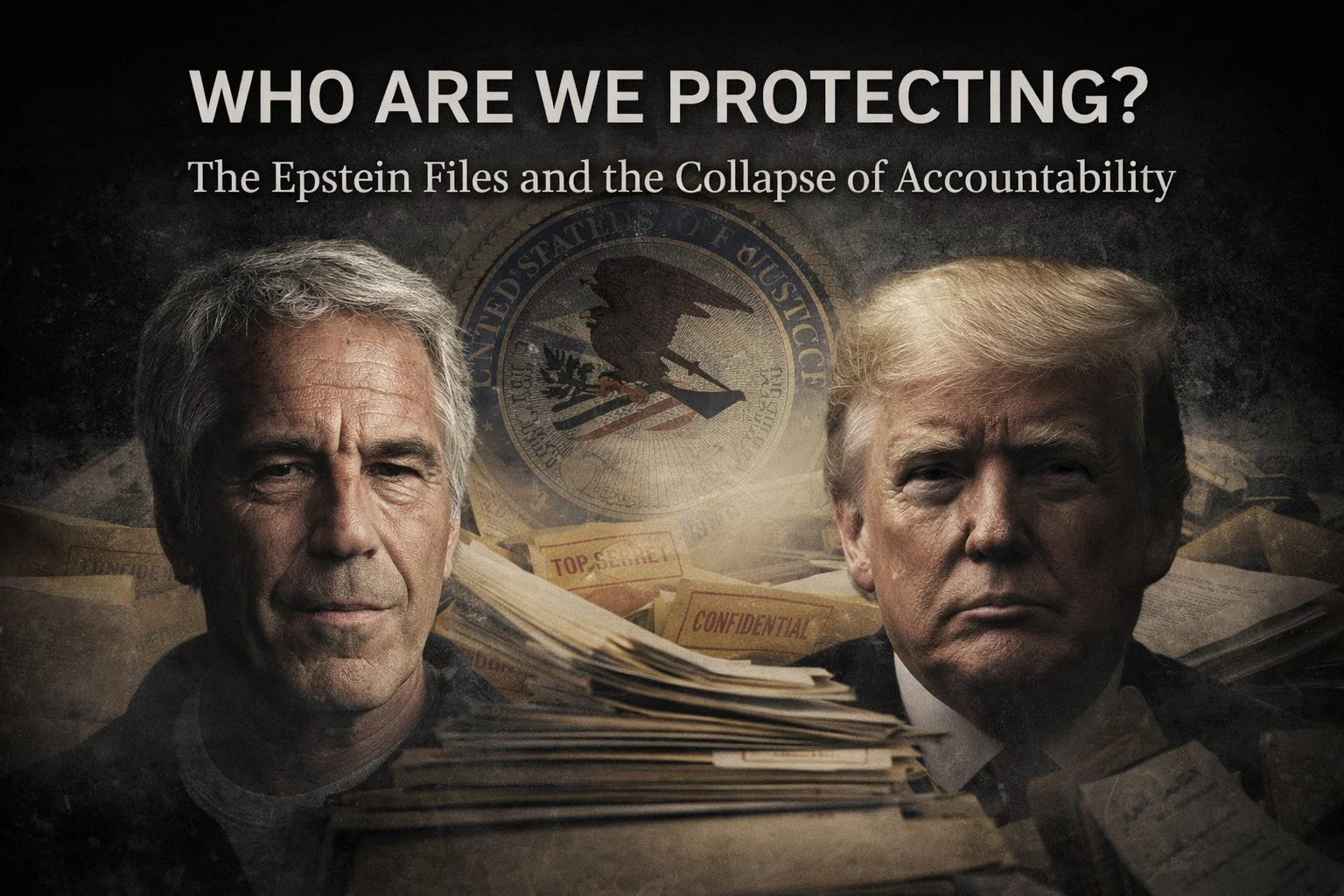
The Epstein Files and the Collapse of Accountability
According to an analysis by the New York Times, the January 2026 release of Jeffrey Epstein documents contains more than 5,300 files with over 38,000 references to Donald Trump, his wife, or Trump-owned properties, including Mar-a-Lago. The Times noted that these references vary widely in significance and do not, on their own, establish criminal conduct.
But the sheer volume of material raises a more troubling issue—one that goes well beyond any single name.
The release is partial by design. The Department of Justice has acknowledged that thousands of additional Epstein-related files exist, yet says it will not release them, arguing that further disclosure is not legally required. At the same time, DOJ officials have announced they do not intend to seek new prosecutions connected to Epstein’s sex-trafficking operation.
The public is left with an unavoidable question: why?
What, exactly, is contained in the files the government refuses to release? And who is being protected by that decision?
The Epstein materials already made public name or reference some of the most powerful and well-connected people in the world—politicians, business leaders, royalty, and cultural elites. The Justice Department insists that withholding the remaining files is consistent with the law. But legality is not the same as legitimacy, and compliance is not the same as justice.
The contradiction is stark.
Hundreds of women have come forward as survivors of Epstein’s trafficking network. Attorneys representing victims say they have worked with more than 200 survivors, many of whom were underage at the time of the abuse. Credible reporting has long established that Epstein systematically recruited and exploited teenage girls, some as young as 14, through a coordinated operation that could not have functioned without help—or at least willful indifference—by others.
And yet, the government now says there is insufficient evidence to bring charges against a single additional person.
Not one.
How does a system arrive at that conclusion? How can an operation that produced hundreds of victims, generated settlements, convictions, sealed agreements, and mountains of documentation somehow produce no prosecutable conduct beyond one dead trafficker and one convicted accomplice?
Transparency without accountability is not justice. It is theater.
A government that can catalog abuse at industrial scale, but declines to test that evidence in court, invites the public to draw its own conclusions. When files are released selectively, prosecutions are ruled out preemptively, and survivors are left with silence instead of answers, the message is unmistakable: some truths are considered too dangerous to fully expose.
Democracies do not collapse only when laws are broken. They erode when power decides which questions are allowed to be asked—and which will never be answered.

Trump’s Plan to End Democracy
Let’s stop pretending this is normal.
Donald Trump’s plan is to stay in power — by any means available.
This isn’t speculation. It isn’t paranoia. It’s a conclusion drawn from his own words, his actions, and the pattern we are watching unfold in real time. If we’re still treating this as politics-as-usual, we are lying to ourselves.
Here’s what we believe is happening — in plain sight.
Trump and those around him are deliberately fomenting violence and chaos in cities and states that did not vote for him. That chaos is not a failure of policy — it is the justification.
The plan is straightforward:
Provoke unrest, then point to it as proof that “order” must be restored by force.
Use that unrest to invoke the Insurrection Act, putting the military on American streets — not to protect democracy, but to control it.
Normalize armed federal presence in cities, so troops and tactical agents become a familiar sight instead of a red flag.
Intimidate state and local governments, making cooperation with federal demands the price of peace.
Seize control of elections by force or coercion — Trump has openly said he wishes he had confiscated voting machines in 2020, and his administration has already demanded access to Minnesota’s voter rolls after federal killings there.
Make fair elections impossible, either by suspending them outright or by rigging the process so outcomes are predetermined.
An Unlawful Attempt to Seize and Hold Power
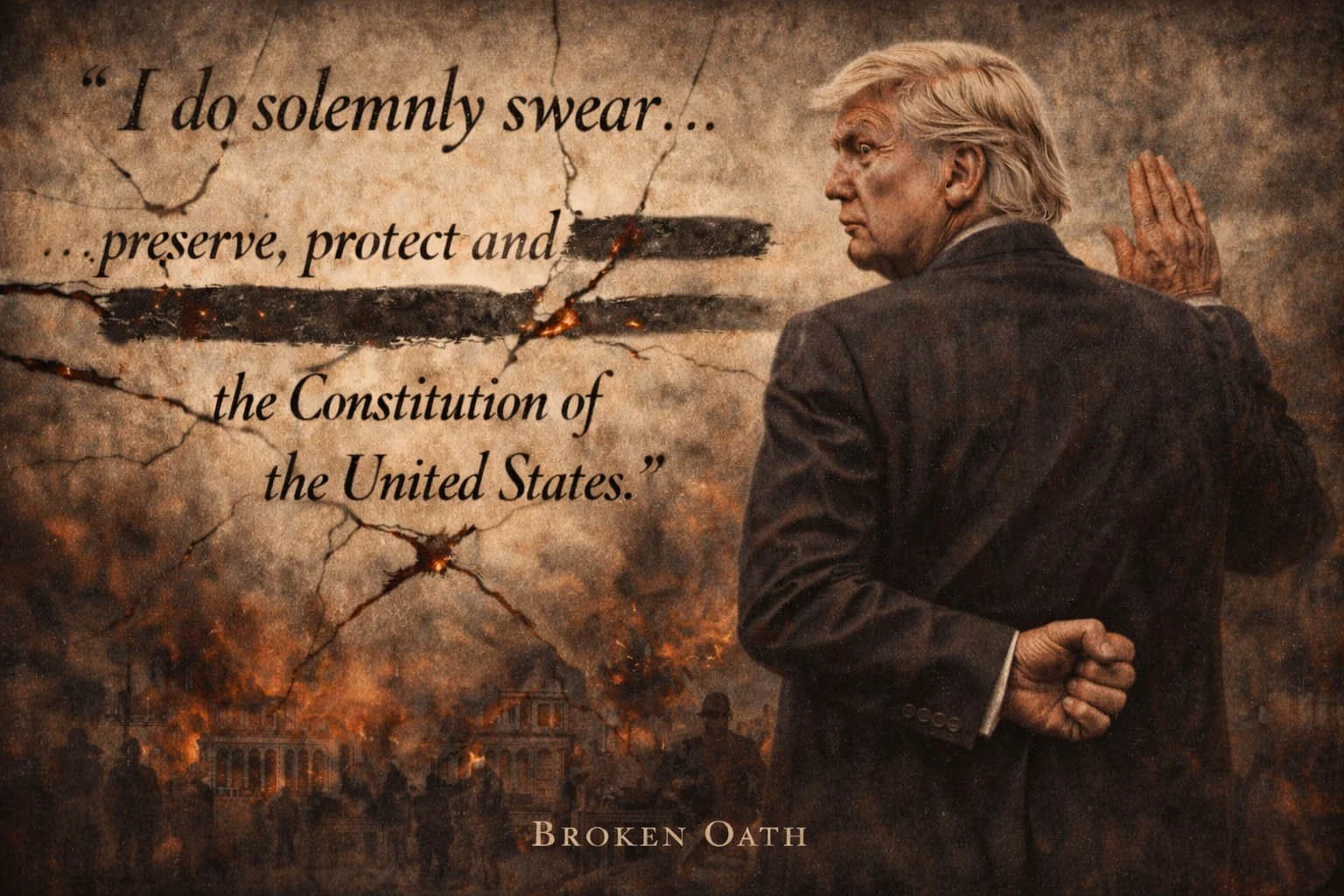
An oath is a promise to the people — not a performance. When power breaks that promise, democracy is what burns.
Let’s stop pretending this is normal.
Donald Trump’s plan is to stay in power — by any means available.
This isn’t speculation. It isn’t paranoia. It’s a conclusion drawn from his own words, his actions, and the pattern we are watching unfold in real time. If we’re still treating this as politics-as-usual, we are lying to ourselves.
Here’s what we believe is happening — in plain sight.
Trump and those around him are deliberately fomenting violence and chaos in cities and states that did not vote for him. That chaos is not a failure of policy — it is the justification.
The plan is straightforward:
Provoke unrest, then point to it as proof that “order” must be restored by force.
Use that unrest to invoke the Insurrection Act, putting the military on American streets — not to protect democracy, but to control it.
Normalize armed federal presence in cities, so troops and tactical agents become a familiar sight instead of a red flag.
Intimidate state and local governments, making cooperation with federal demands the price of peace.
Seize control of elections by force or coercion — Trump has openly said he wishes he had confiscated voting machines in 2020, and his administration has already demanded access to Minnesota’s voter rolls after federal killings there.
Make fair elections impossible, either by suspending them outright or by rigging the process so outcomes are predetermined.
That’s how the 2026 midterms get stolen.
That’s how a coup is completed in 2028.
This strategy only works if people stop trusting what they can see with their own eyes — and start accepting whatever they are told by those in power. That is why lying is not a side effect of this moment. It is the point.
Look at Minneapolis.
Federal agents killed civilians. Video exists. Witnesses exist. The evidence is not ambiguous. And yet the government’s response has been to lie — brazenly — about what happened. To insist the killings were justified. To deny what the footage plainly shows. To tell the public, in effect: don’t believe what you’re seeing.
This isn’t about one city. Minneapolis matters because it fits a pattern. Violence is followed by denial. Denial is followed by loyalty tests. Supporters are asked to choose: do you believe the evidence — or do you believe us? Every time people choose power over truth, the ground beneath democracy erodes a little more.
For millions of Americans, this reality is difficult — and in some cases nearly impossible — to see clearly. Not because the evidence isn’t there, but because they are being systematically lied to by right-wing media outlets that function as propaganda, not journalism. These outlets don’t exist to inform. They exist to condition. To train audiences to distrust any source that contradicts the approved narrative.
When people are taught to reject all independent evidence and believe only what power tells them, truth becomes optional. And when truth becomes optional, democracy cannot survive.
None of this began in Minneapolis.
It runs straight through the lies about the 2020 election, the months of deliberate disinformation that followed, and the violent attack on the U.S. Capitol on January 6 — an attack Donald Trump incited. He summoned the crowd. He fed them lies. He sent them to the Capitol. When they breached the building and assaulted police officers, he watched — and did nothing. Since then, he has praised the insurrectionists as “patriots,” rewritten what happened that day, and pardoned those who tried to overturn a lawful election.
January 6 was not an aberration. It was a rehearsal.
What we are witnessing now is the same effort — continued, refined, and escalated.
That is why Trump’s recent remark about the midterms matters so much. When he said we “shouldn’t even have an election,” his press secretary later claimed he was joking. But when a president who already tried to overturn an election says something like that, the explanation doesn’t matter.
In a functioning democracy, that sentence is never uttered. Not casually. Not rhetorically. Not even as a joke.
The final requirement for authoritarianism is not violence. It is obedience. And obedience becomes possible only when people are convinced to abandon their own judgment.
George Orwell warned about this exact moment:
“The Party told you to reject the evidence of your eyes and ears. It was their final, most essential command.”
That command is no longer fictional.
When a government asks you to ignore video, dismiss witnesses, distrust journalists, and believe only what it tells you — it is no longer governing. It is asserting control.
This is not about left versus right. It is about whether facts still matter. Whether elections still mean something. Whether the rule of law still applies to those in power.
Democracy does not collapse all at once. It is hollowed out slowly — by lies repeated often enough to feel normal, by violence justified as necessity, and by citizens encouraged to look away instead of confront what they see.
The question before us is not complicated, but it is urgent:
When power demands your loyalty at the expense of truth,
do you comply — or do you resist?
Because once people are trained to stop believing their own eyes,
there is no limit to what they can be made to accept.
This piece reflects the editorial position of The People’s Democracy.
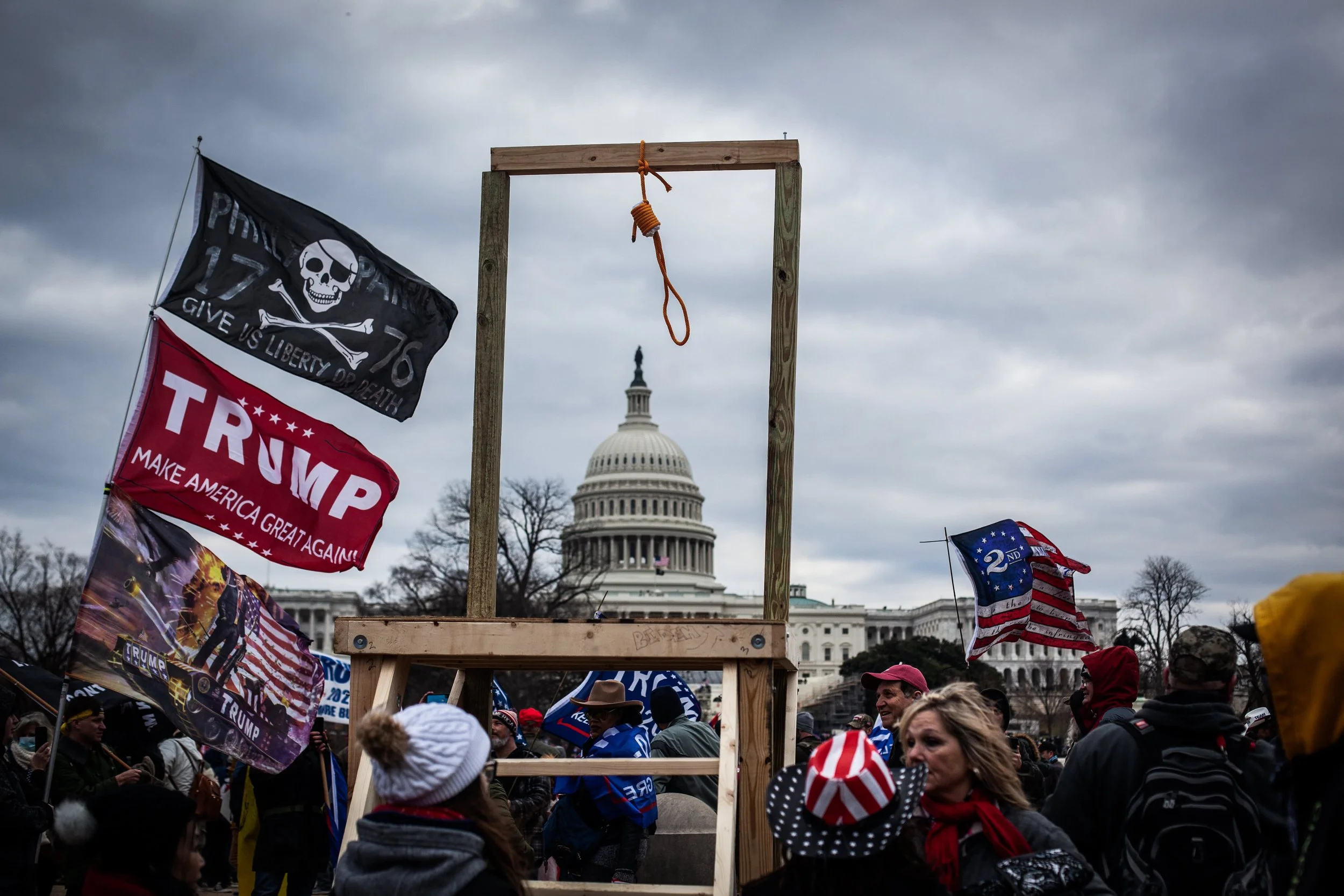
When Tribe Replaces Truth, Democracy Dies
In a healthy democracy, disagreement is expected—even necessary. Citizens weigh evidence differently, prioritize different values, and argue over solutions. But something far more dangerous has taken hold in recent years: the steady replacement of truth with loyalty, and evidence with allegiance.
What we are witnessing is not simply polarization. It is the erosion of shared reality itself.
Social scientists have long studied this phenomenon. It’s often called identity-protective cognition or motivated reasoning—the tendency to interpret information in ways that preserve one’s standing within a group. When beliefs become fused with identity, facts stop functioning as tools for understanding and begin to feel like threats.
At that point, truth is no longer evaluated on its merits. It is accepted or rejected based on who it helps—and who it hurts.
This vulnerability is not unique to any one ideology. It is human. But in an era of algorithm-driven media, coordinated disinformation, and political incentives that reward loyalty over honesty, its consequences have become impossible to ignore.
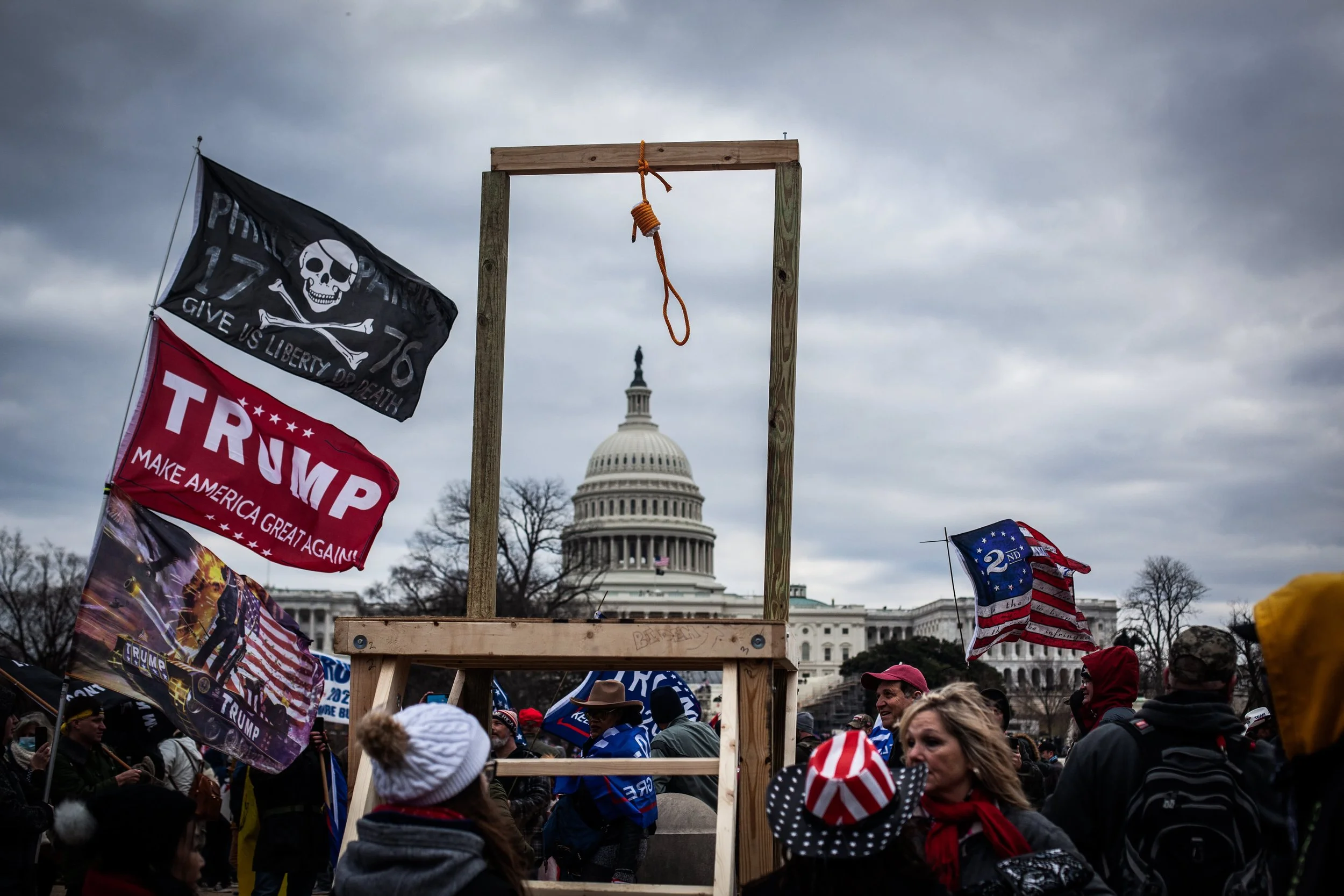
What we are witnessing is not simply polarization. It is the erosion of shared reality itself. The danger is training millions of people to distrust reality itself.
In a healthy democracy, disagreement is normal—even necessary. Citizens weigh evidence differently, prioritize different values, and argue over solutions. But something far more dangerous has taken hold in recent years: the steady replacement of truth with loyalty, and evidence with allegiance.
What we are witnessing now is not merely polarization. It is the erosion of shared reality itself.
Social scientists have long studied this phenomenon. It’s often called identity-protective cognition or motivated reasoning—the tendency to interpret information in ways that preserve one’s standing within a group. When beliefs become fused with identity, facts stop functioning as tools for understanding and begin to feel like threats.
At that point, truth is no longer evaluated on its merits. It is accepted or rejected based on who it helps—and who it hurts.
This isn’t a flaw unique to one political party or ideology. It’s a human vulnerability. But in an era of algorithm-driven media, coordinated disinformation, and power structures that reward loyalty over honesty, its consequences have become impossible to ignore.
How Tribal Thinking Overrides Reality
Decades of research in social psychology show that humans are not neutral processors of information. We instinctively favor claims that affirm our group identity and discount those that challenge it—even when the evidence is overwhelming.
Studies by Yale researcher Dan Kahan and others reveal a deeply unsettling truth: higher education and intelligence do not necessarily protect against bias. In many cases, they simply make people more skilled at defending the beliefs of their group. Reason becomes a weapon for justification rather than a tool for correction.
This helps explain a growing paradox in American life: why large numbers of people now defend statements that are demonstrably false, excuse conduct that violates their stated values, or dismiss clear evidence as fabrication—so long as the source aligns with their tribe.
When Power Exploits Tribal Loyalty
Tribal thinking becomes especially dangerous when it is deliberately cultivated by those in power.
We have seen repeated examples of government officials and aligned media outlets promoting narratives that collapse under even minimal scrutiny—altered images presented as evidence, false claims denied despite clear video records, and official statements that contradict documented facts. When these claims are challenged, the response is rarely correction. It is denial, deflection, or attack.
In these moments, loyalty becomes the test of belonging. To acknowledge reality is framed as betrayal. To ask questions is to side with the enemy.
This dynamic has real-world consequences.
In Minneapolis and elsewhere, ICE operations have resulted in innocent people—lawful residents and citizens—being detained, injured, and in some cases killed. Yet official narratives often bear little resemblance to verified evidence. When government accounts are demonstrably false and no independent investigation follows, the issue is no longer policy disagreement. It is institutional unaccountability.
The same pattern appears in healthcare. Millions of Americans are losing coverage or facing rising premiums, even as political leaders insist conditions are improving or promise plans that never materialize. Documented outcomes are dismissed. Failures are rebranded as successes. And the public is asked—again—to trust loyalty over evidence.
Why Disinformation Thrives in Tribal Environments
Misinformation does not spread because people lack access to facts. It spreads because certain claims feel right within a group’s story.
When identity is at stake:
Contradictory evidence is dismissed as biased or corrupt
Independent journalism is replaced with loyal media
Correction is treated as attack
Truth becomes conditional
Over time, this produces a breakdown of shared reality. Citizens are no longer arguing about solutions; they are arguing about whether basic facts exist at all.
At that point, democratic decision-making becomes impossible.
What This Means for Democracy
Democracy does not require consensus. But it does require a common factual foundation.
When tribal allegiance consistently overrides truth:
Policy failures repeat without accountability
Institutions weaken under sustained dishonesty
Violence becomes easier to justify
Citizens lose the ability to self-govern
This is why leading historians and constitutional scholars now openly question whether democratic norms—and even constitutional safeguards—can withstand sustained, organized disinformation paired with loyalty-based power.
The danger is not that people disagree.
The danger is that millions are being conditioned to distrust reality itself.
The Question We Can No Longer Avoid
None of us are immune to tribal thinking. The question is not whether identity influences belief—it always does. The question is whether we are willing to recognize when loyalty demands the abandonment of truth.
Because when citizens choose tribe over evidence, they are not merely choosing sides.
They are choosing tribe over accountability.
Tribe over democracy.
Tribe over the shared reality that makes freedom possible.
The future will not be decided by who shouts the loudest—but by who is willing to remain honest when honesty carries a cost.
Rebuilding shared truth begins with that choice.
The People’s Democracy
Shared truth is not optional. It is the foundation of self-government.
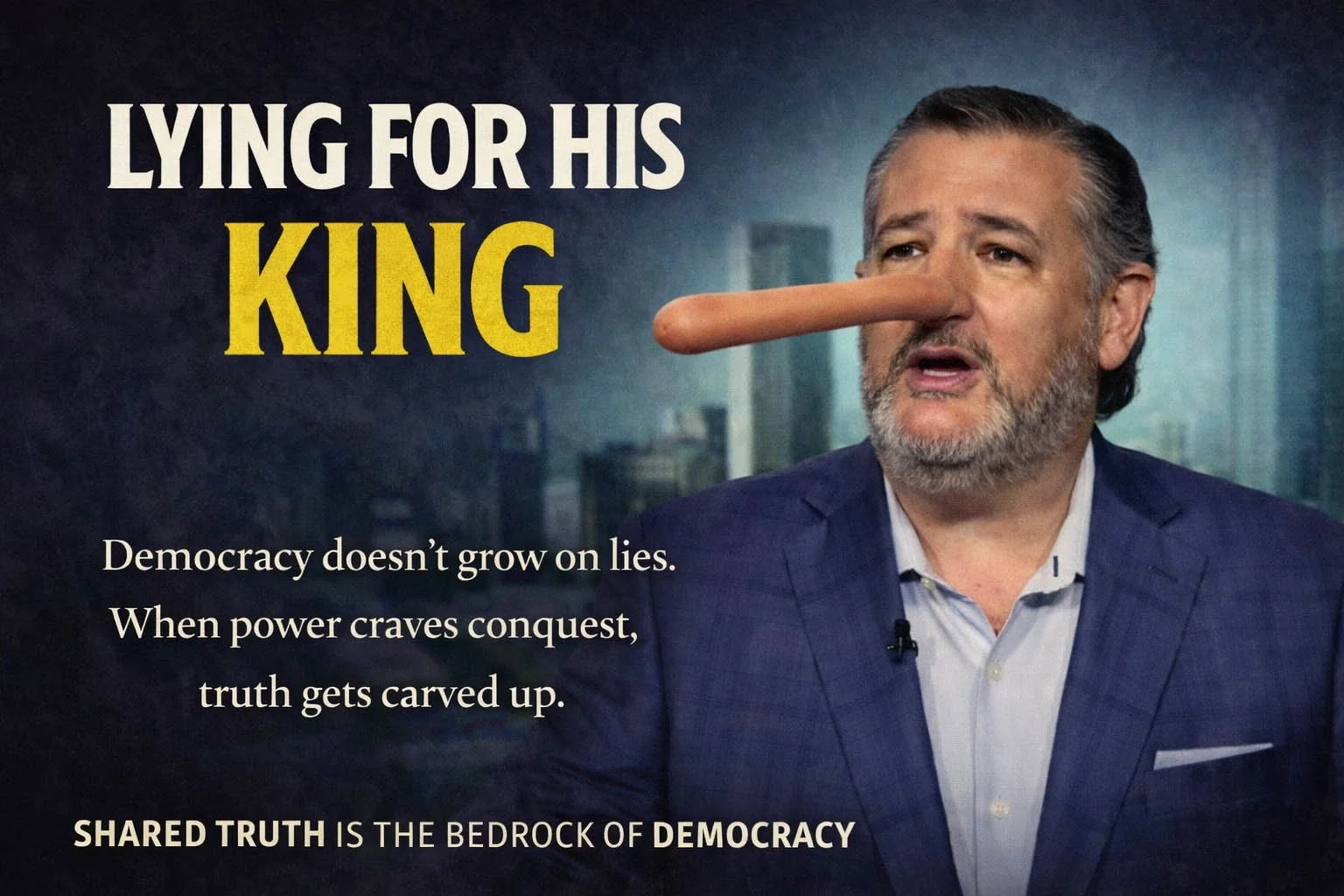
Ted Cruz Isn’t Defending Policy — He’s Defending a King
You can’t defend democracy while kneeling to a king
Let’s be clear: Greenland is not for sale.
It’s not a bargaining chip.
It’s not a colonial outpost.
And it’s not a consolation prize for a leader who couldn’t win the Nobel Peace Prize the honest way.
But that didn’t stop Senator Ted Cruz from going on Fox News this week to say it’s “overwhelmingly in America's national interest to acquire Greenland,” praising Donald Trump for being “single-mindedly focused on America First.”
It would be laughable—if it weren’t so dangerous.
Because behind this fantasy is a worldview that’s all too real:
One where power matters more than people.
Where flattery replaces diplomacy.
Where leaders treat sovereignty like real estate, and democracy like branding.
You can’t defend democracy while kneeling to a king
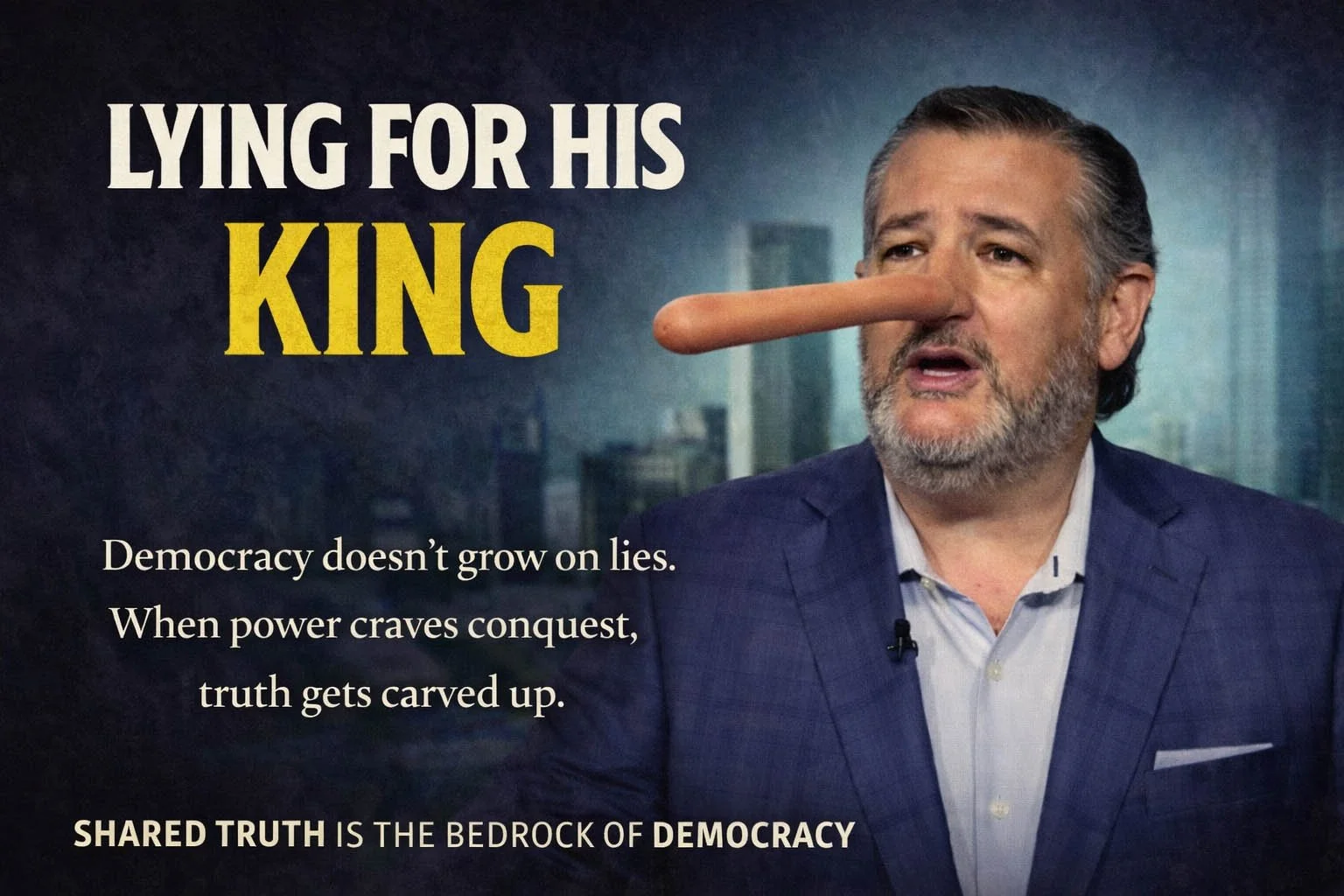
When truth bends to power, the lies don’t stop — they grow. Democracy doesn't survive men like this.
Let’s be clear: Greenland is not for sale.
It’s not a bargaining chip.
It’s not a colonial outpost.
And it’s not a consolation prize for a leader who couldn’t win the Nobel Peace Prize the honest way.
But that didn’t stop Senator Ted Cruz from going on Fox News this week to say it’s “overwhelmingly in America's national interest to acquire Greenland,” praising Donald Trump for being “single-mindedly focused on America First.”
It would be laughable—if it weren’t so dangerous.
Because behind this fantasy is a worldview that’s all too real:
One where power matters more than people.
Where flattery replaces diplomacy.
Where leaders treat sovereignty like real estate, and democracy like branding.
What’s really happening?
Greenland is an autonomous territory within the Kingdom of Denmark. It has its own government, culture, and legal system. The vast majority of its population is Indigenous Inuit — a people with no interest in becoming a U.S. asset.
To suggest otherwise isn’t just insulting — it’s colonialist.
It erases Indigenous agency, violates international norms, and stomps all over the democratic principle of self-determination.
But Trump doesn’t care about that.
And apparently, neither does Cruz.
Instead, they sell a fantasy:
That “America First” means taking what we want — simply because we can.
That expansionism isn’t a stain of our past, but a roadmap for our future.
That empire is strength, and restraint is weakness.
Let’s call it what it is:
Performative imperialism in a populist crown.
It’s not patriotic. It’s not serious.
And it’s certainly not democratic.
Because when leaders blur the line between fantasy and foreign policy, they don’t just erode credibility — they erode the very norms that hold peace in place.
And let’s not ignore the racial undertones:
Colonial thinking has always justified the exploitation of Indigenous land and identity in the name of national interest.
Greenland is just the latest object of this legacy — a mostly non-white territory reduced to a trophy for white power fantasies.
Cruz isn’t thinking about the people of Greenland.
He’s not thinking about America’s moral authority.
He’s thinking about one man — and how to stay in his favor.
And that man isn’t a president anymore.
He’s a king in exile, still collecting fealty from those too weak to stand without him.
This isn’t strategy.
It’s sycophancy.
And if we don’t call it out — forcefully, truthfully, and with historical clarity — it will spread.
Truth in Crisis — Part III
Why Democracy Now Requires Constitutional Accountability
In Part I of this series, we examined how the First Amendment—one of the greatest achievements in democratic history—was never designed for a world of instantaneous, mass-scale information. In Part II, we explored how legal doctrines meant to protect free expression have been exploited to insulate intentional deception, allowing disinformation to spread with minimal consequence.
Together, these realities bring us to an unavoidable question:
If democracy depends on shared truth, and shared truth has collapsed, what responsibility does the Constitution have to evolve?
This is not a question about censorship. It is a question about accountability.
Why Democracy Now Requires Constitutional Accountability
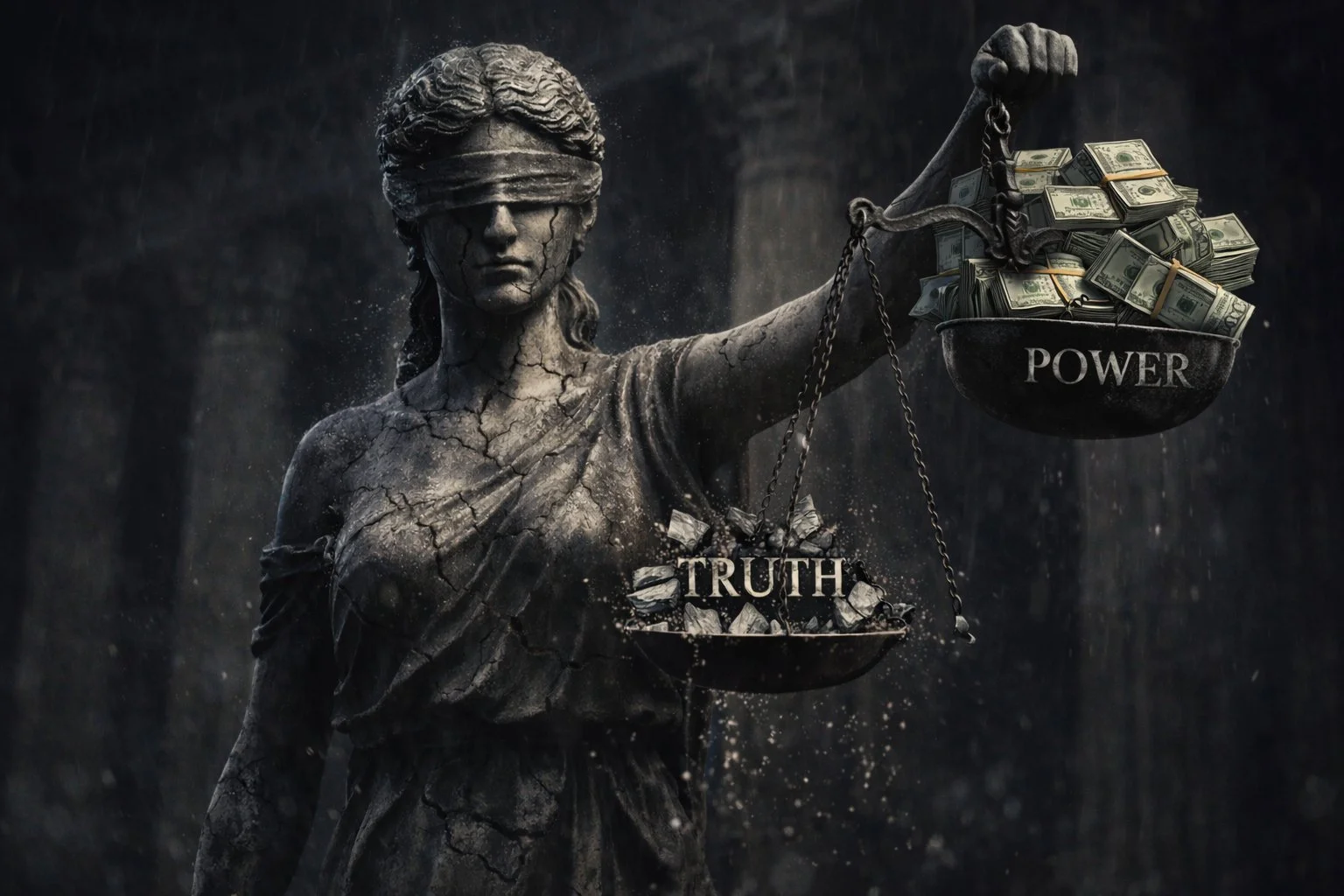
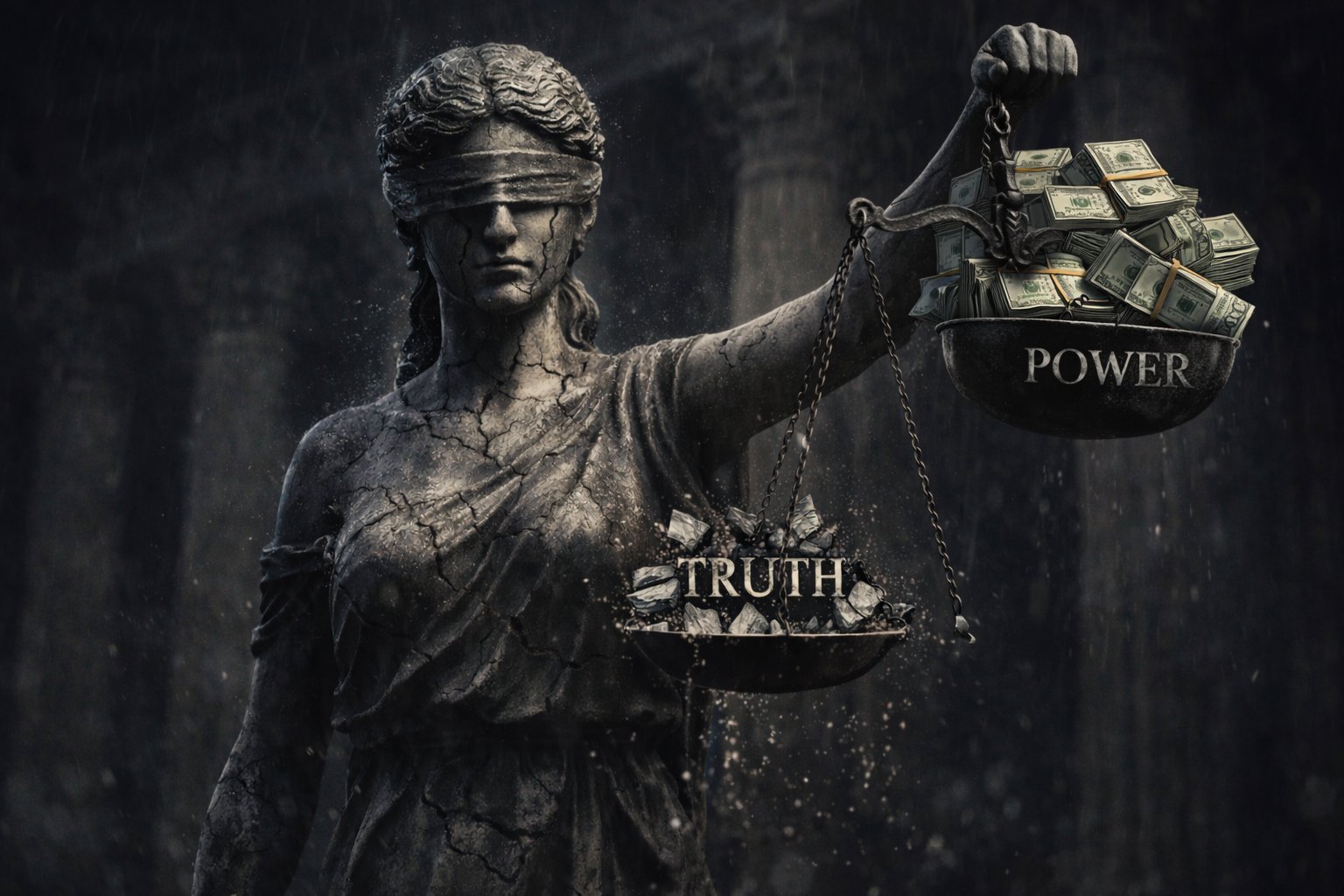
Truth shatters. Money rises. Democracy can’t survive that imbalance. It erodes—quietly, then all at once.
In Part I of this series, we examined how the First Amendment—one of the greatest achievements in democratic history—was never designed for a world of instantaneous, mass-scale information. In Part II, we explored how legal doctrines meant to protect free expression have been exploited to insulate intentional deception, allowing disinformation to spread with minimal consequence.
Together, these realities bring us to an unavoidable question:
If democracy depends on shared truth, and shared truth has collapsed, what responsibility does the Constitution have to evolve?
This is not a question about censorship. It is a question about accountability.
Free Speech and Shared Truth Are Not Opposites
Free speech is essential to democracy. It protects dissent, empowers minorities, and ensures that those in power can be challenged. But free speech alone is not sufficient for self-government.
Democracy does not require agreement.
It does require a shared factual baseline.
Citizens cannot deliberate, vote, or hold leaders accountable if reality itself is fragmented—if facts are optional, lies are profitable, and deception carries no consequence. In such an environment, speech remains free, but democracy becomes hollow.
This is the condition we now face.
What This Is Not About
Any discussion of constitutional reform must begin by drawing clear boundaries.
This is not about:
Banning opinion
Criminalizing dissent
Government control of ideas
Punishing honest mistakes or good-faith reporting
Opinion deserves protection. Advocacy deserves protection. Political speech deserves protection.
What does not deserve protection is intentional, knowing deception presented as truth to mass audiences under the authority of journalism.
That distinction is not radical. It is foundational.
Intent Matters
Every functioning legal system recognizes intent. Fraud law, consumer protection law, and civil liability all hinge on whether deception was knowing and deliberate.
The same principle must apply to modern information power.
There is a fundamental difference between:
Being wrong
Being misleading
Being mistaken in real time
And:
Knowingly spreading false factual claims
Repeating those claims after they have been disproven
Continuing to profit from deception while denying accountability
Democracy cannot survive if those behaviors are treated as cost-free.
Power Requires Responsibility
The framers assumed speech power was diffuse. They did not anticipate a handful of institutions reaching tens of millions of people daily, shaping political identity, public trust, and electoral outcomes.
In every other domain of democratic life, power carries obligation:
Financial institutions are regulated
Advertising is subject to truth-in-representation standards
Public companies must disclose material facts
Only mass media—despite its enormous influence—operates without comparable responsibility.
This is not a defense of regulation for its own sake. It is a recognition that unaccountable power corrodes democracy, no matter its form.
What Constitutional Accountability Could Look Like
Any constitutional evolution must be narrow, principled, and precise. The goal is not control—it is integrity.
At minimum, reform must address three principles:
1. Truth in Representation
If an outlet presents itself as “news,” uses journalistic authority, and reaches mass audiences, it must be legally obligated to distinguish fact from opinion and correct known falsehoods.
2. Consequences for Intentional Deception
When false factual claims are knowingly spread and repeated, consequences must be proportional to the harm caused—civil, not criminal, and adjudicated through courts, not political bodies.
3. Protection for Good-Faith Speech
Any reform must explicitly protect dissent, advocacy, satire, and honest reporting, ensuring that accountability applies only to deliberate deception, not disagreement.
These are not censorship tools. They are democratic safeguards.
Why This Cannot Wait
History shows that democracies rarely collapse overnight. They erode gradually—when trust disappears, when truth fragments, and when citizens no longer believe their institutions operate in good faith.
The United States is not immune.
When lies become loyalty tests, when outrage replaces deliberation, and when reality itself is contested, democratic self-government becomes impossible—even if elections continue.
Free speech protects voices.
Democracy requires truth.
The Constitution has been amended before to correct unintended consequences, expand rights, and meet the demands of a changing society. Treating the First Amendment as untouchable doctrine rather than a living framework does not honor the framers—it freezes democracy in a world that no longer exists.
The question is no longer whether reform is controversial.
The question is whether democracy can survive without it.
Shared truth is not a luxury.
It is a requirement.
Truth in Crisis — Part II
How Disinformation Became Legally Untouchable
In Part I of this series, we explored how the First Amendment—written for pamphlets and printing presses—has struggled to govern a modern information ecosystem defined by speed, scale, and profit. That mismatch created a dangerous gap: while speech is protected from government suppression, the public is left largely unprotected from intentional deception.
That gap did not emerge by accident. It has been exploited—methodically, legally, and profitably.
Today, some of the most damaging falsehoods in American public life are not spread in spite of the law, but because of how the law is structured. Over time, powerful media organizations and online personalities have learned how to operate within the letter of the First Amendment while undermining the democratic purpose it was meant to serve.
Four legal and structural shields make this possible.
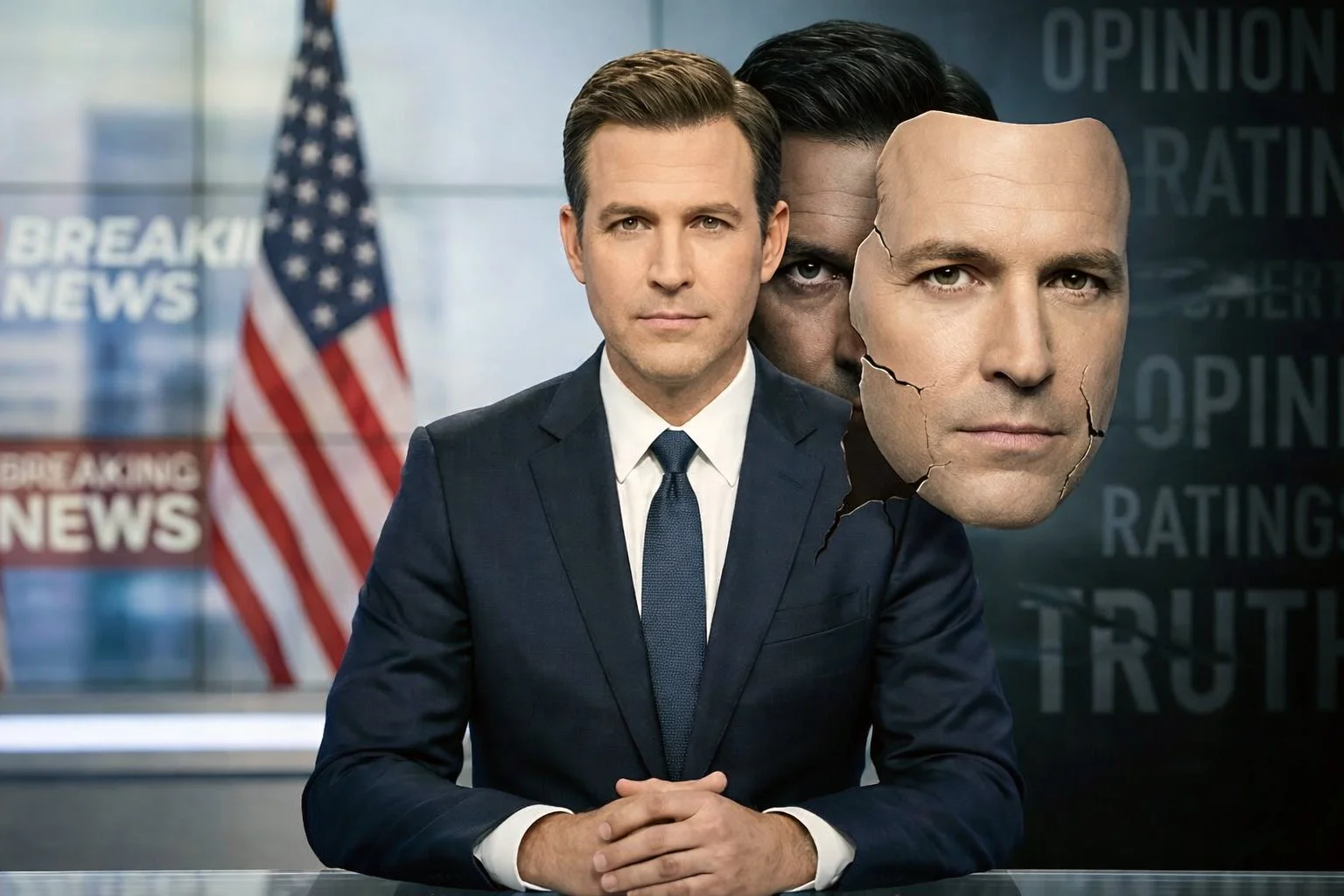
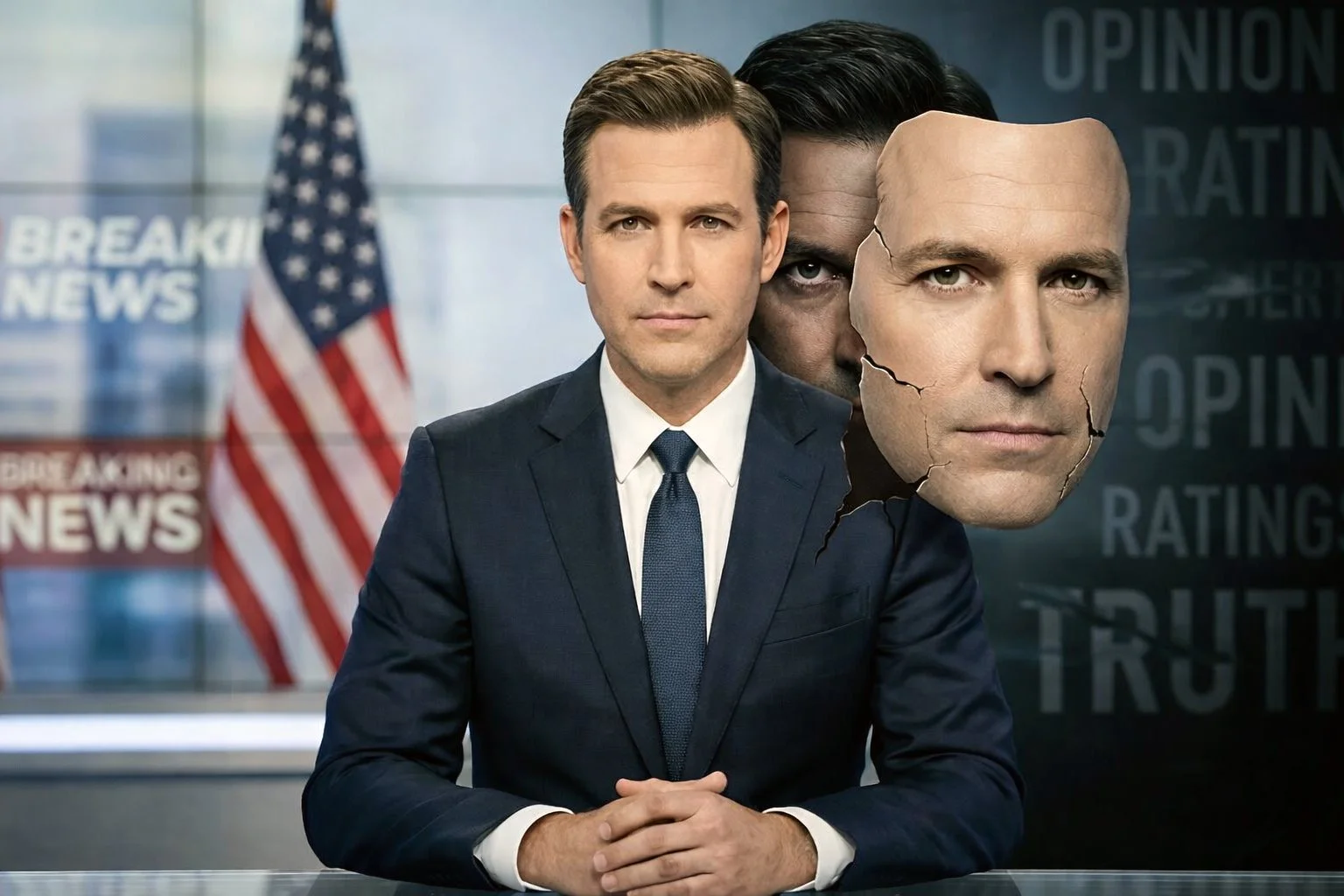
Behind the studio lights: power, profit, and a manufactured reality. They don’t inform you. They engineer you.
How Disinformation Became Legally Untouchable
In Part I of this series, we explored how the First Amendment—written for pamphlets and printing presses—has struggled to govern a modern information ecosystem defined by speed, scale, and profit. That mismatch created a dangerous gap: while speech is protected from government suppression, the public is left largely unprotected from intentional deception.
That gap did not emerge by accident. It has been exploited—methodically, legally, and profitably.
Today, some of the most damaging falsehoods in American public life are not spread in spite of the law, but because of how the law is structured. Over time, powerful media organizations and online personalities have learned how to operate within the letter of the First Amendment while undermining the democratic purpose it was meant to serve.
Four legal and structural shields make this possible.
1. Opinion as a Legal Shield
The most significant protection for modern disinformation is the legal distinction between fact and opinion.
Courts give wide latitude to opinion, recognizing that democratic debate requires room for interpretation, advocacy, and even provocation. That protection is essential. But it has been weaponized.
Today, opinion programming often adopts the full visual and rhetorical language of journalism—news desks, breaking banners, authoritative tone—while delivering false factual claims. When challenged, these same programs retreat behind the claim that they are merely offering opinion or entertainment, and that no reasonable viewer should interpret their statements as literal fact.
This creates a shell game.
Viewers are encouraged to treat the content as news. Courts are asked to treat it as performance. The result is a system in which factual falsehoods can be broadcast nightly to millions, so long as they are wrapped in opinion framing.
Opinion deserves protection.
Disinformation does not.
2. The “Actual Malice” Barrier
Even when false statements cause demonstrable harm, legal accountability is extraordinarily difficult to achieve.
Under long-standing Supreme Court precedent, public figures seeking to prove defamation must demonstrate “actual malice”—that a statement was false and that the speaker knew it was false or acted with reckless disregard for the truth.
This standard was established to protect a free press from intimidation and censorship. But in the modern media environment, it has become an almost insurmountable barrier.
Proving actual malice requires access to internal communications, editorial deliberations, and private acknowledgments—materials that are rarely available without years of litigation and immense financial resources. As a result, most cases fail long before reaching trial.
Accountability becomes the exception, not the rule.
3. No Truth-in-News Requirement
Contrary to popular belief, there is no general legal requirement in the United States that news outlets be truthful.
The Federal Communications Commission does not regulate cable news content. The Fairness Doctrine no longer exists. There is no federal “truth in reporting” standard comparable to consumer protection laws that govern advertising or financial disclosures.
Enforcement is almost entirely civil, not regulatory. That means accountability depends on private lawsuits—slow, expensive, and often inaccessible to ordinary citizens.
In practice, this creates a vacuum: a system where the most powerful voices face the fewest consequences.
4. Money, Power, and Delay
Even when lies cross legal thresholds, the realities of wealth and time intervene.
Litigation takes years. Legal teams cost millions. Most individuals, journalists, and organizations cannot afford to pursue justice through the courts. By the time a case is resolved—if it ever is—the damage to public trust, democratic norms, and civic cohesion has already been done.
Rare exceptions prove the rule. Only entities with extraordinary resources and access to internal evidence have been able to break through this wall. Those cases are not signs of a healthy system—they are signs of how broken it has become.
What This System Produces
Together, these four shields create a predictable outcome:
False factual claims spread widely
Corrections arrive late, if at all
Accountability is rare
Trust erodes
Anger replaces deliberation
This is not an accident. It is the logical consequence of a legal framework that protects speech without accounting for power, reach, or intent.
The First Amendment does not grant the right to lie.
But it has created a system in which powerful media organizations can spread disinformation with minimal accountability.
That distinction matters.
Democracy depends not on agreement, but on a shared factual baseline. When that baseline collapses—when opinion becomes a delivery system for lies—self-government becomes impossible.
This is not a call to suppress speech. It is a call to confront a reality we can no longer afford to ignore.
If intentional deception carries no consequence, democracy cannot survive.
Part III will examine why restoring shared truth now requires constitutional accountability—and what reform could look like without threatening free expression.
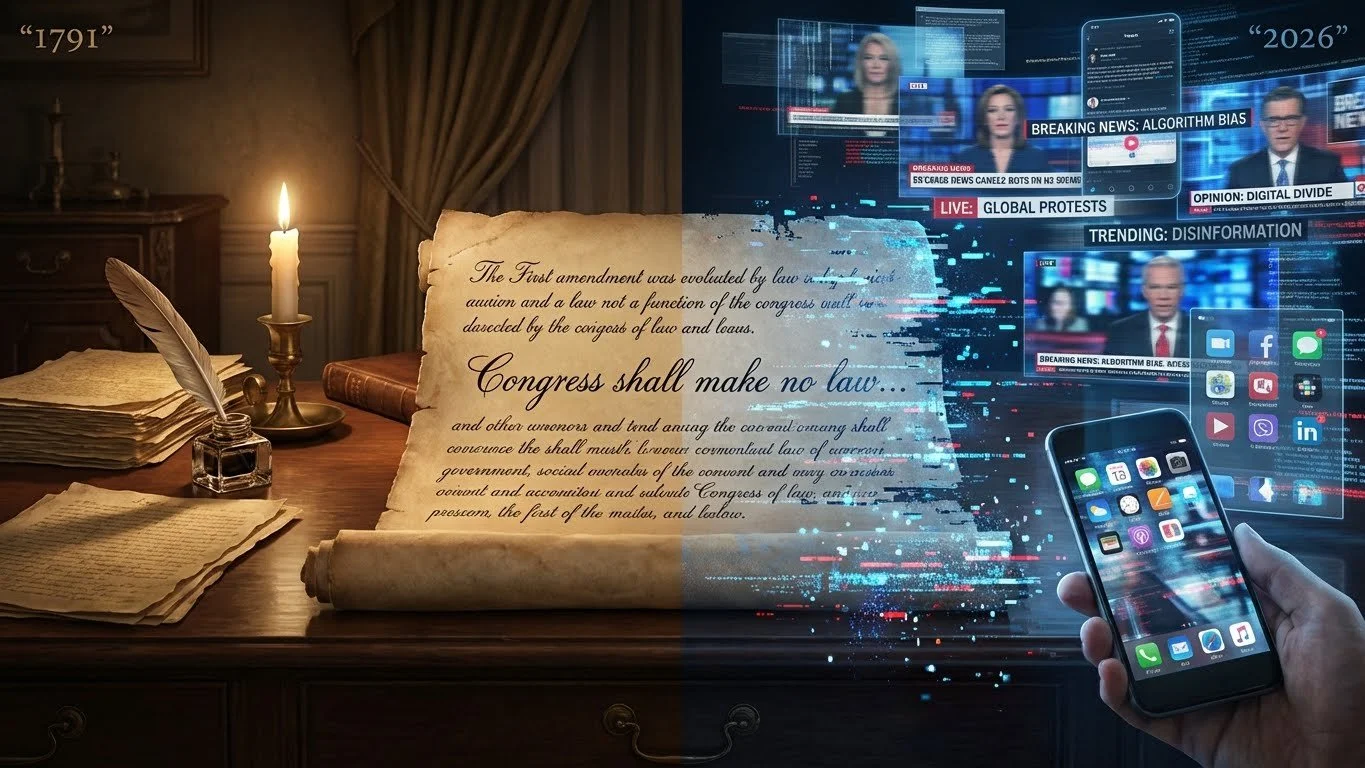
Truth in Crisis — Part I
The First Amendment Wasn’t Built for This
The First Amendment is one of the greatest achievements in human history. It protects dissent, guards against tyranny, and ensures that those in power can be challenged without fear of government reprisal. It is foundational to American democracy—and indispensable to a free society.
But it was not built for the world we now inhabit.
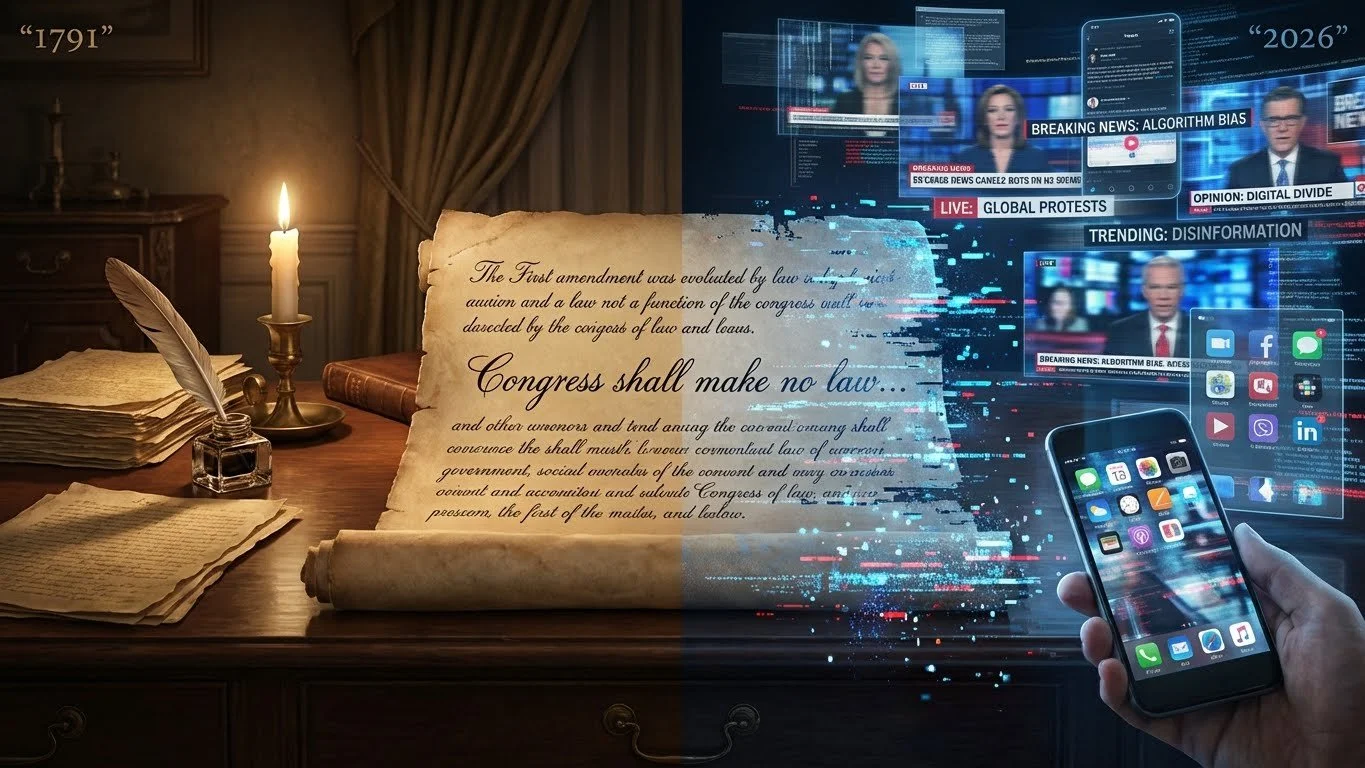
1791 protected speech from government power. 2026 tests whether truth can survive industrial deception.
The First Amendment Wasn’t Built for This
The First Amendment is one of the greatest achievements in human history. It protects dissent, guards against tyranny, and ensures that those in power can be challenged without fear of government reprisal. It is foundational to American democracy—and indispensable to a free society.
But it was not built for the world we now inhabit.
When the First Amendment was written in the late 18th century, “the press” meant printed pamphlets and newspapers. Information traveled slowly. Distribution took days or weeks. Reach was local or regional. Editors were identifiable. Accountability—while imperfect—was real. Errors could be challenged. Falsehoods could be rebutted. Debate had time to breathe.
The framers were protecting political dissent from government suppression. They were not designing a system for instantaneous, global, profit-driven influence machines capable of shaping reality itself.
That distinction matters.
Today, information moves at the speed of light. Falsehoods travel faster than verification, faster than correction, and faster than any legal remedy. The constitutional system assumes time exists for rebuttal and debate. In the modern media ecosystem, damage is often done before truth can respond.
This is not a failure of free speech. It is an unintended consequence of its success.
Over time, three fundamental changes have reshaped the information landscape in ways the Constitution could not have anticipated.
First, speed without friction.
The framers assumed that bad ideas could be countered by better ones. That assumption relied on time—time for scrutiny, time for response, time for reason to prevail. Today, a false claim can reach millions in seconds, amplified by algorithms designed to reward outrage rather than accuracy. Retractions, corrections, and fact-checks rarely travel as far or as fast as the original lie.
Second, entertainment disguised as journalism.
The First Amendment protects speech. Courts protect opinion. Modern media organizations have learned to exploit this distinction by presenting opinion programming using the visual language and authority of journalism—news desks, chyrons, breaking-news graphics—while later claiming “entertainment” when challenged. Viewers are told to treat the content as news, but courts are asked to treat it as performance.
This is not classical free speech. It is identity laundering.
Third, scale without responsibility.
The framers assumed speech power was relatively diffuse. No single voice could dominate national discourse. Today, a handful of media outlets and online personalities reach tens of millions of people daily, shaping political behavior, public perception, and even democratic outcomes—often with no meaningful obligation to correct known falsehoods.
The First Amendment was designed to protect the speaker from the state.
It was not designed to protect the public from systematic deception.
That gap has grown enormous.
This moment did not arise because Americans value free speech too much. It arose because our legal framework has not evolved alongside the information ecosystem it now governs. The result is a system where intentional deception can flourish, so long as it is labeled “opinion,” monetized effectively, and insulated by wealth and legal complexity.
This is not about censorship. It is about classification, accountability, and civic responsibility.
Democracy does not require agreement. It requires a shared factual baseline—a common understanding of what is real. Without that foundation, debate collapses into tribalism, elections become identity battles, and anger replaces deliberation.
History offers a warning here. Democracies do not typically fall because citizens stop caring. They fall when truth becomes optional, when reality fractures, and when lies carry no consequence.
The framers of the Constitution could not have foreseen an information ecosystem where entertainers masquerade as journalists, where falsehoods are monetized at scale, and where millions are misled in real time. That does not diminish the First Amendment. It challenges us to take it seriously enough to confront its unintended consequences.
Free speech was meant to protect dissent—not to shield disinformation at industrial scale.
This is the question now before us:
If democracy depends on shared truth, and shared truth has collapsed, what responsibility does the Constitution have to evolve?
Part II will examine how modern media organizations legally insulate disinformation—and why existing safeguards have failed to protect the public.
When a Country Loses Its Soul
The death in Minneapolis is not an anomaly. It's part of a national unraveling — where cruelty is policy, lies replace truth, and democracy itself is on life support.
A woman is dead.
• Shot by a federal agent in Minneapolis.
• An ICE operation with no local justification.
• No crime. No threat. No explanation that makes it right.
This wasn’t law enforcement. It was spectacle — state violence as political theater. It happened because cruelty has become the point.
But this is bigger than one tragedy. It’s a symptom. Of a doctrine. Of a worldview.
One that has pulled America to the edge.
The death in Minneapolis is not an anomaly. It's part of a national unraveling — where cruelty is policy, lies replace truth, and democracy itself is on life support.
A woman is dead.
• Shot by a federal agent in Minneapolis.
• An ICE operation with no local justification.
• No crime. No threat. No explanation that makes it right.
This wasn’t law enforcement. It was spectacle — state violence as political theater. It happened because cruelty has become the point.
But this is bigger than one tragedy. It’s a symptom. Of a doctrine. Of a worldview.
One that has pulled America to the edge.
This Is What a Nation in Decline Looks Like:
🔹 Democratic norms shredded.
Trump’s allies ignore subpoenas, threaten judges, and openly vow to rewrite the Constitution. The rule of law is now optional — if you’re in power.
🔹 Federal agencies turned into weapons.
The DOJ still hasn’t complied with the court order to release the Epstein files. Who are they protecting — and why?
🔹 Naked imperialism, rebranded as policy.
Trump is taking Venezuela’s oil. He’s threatening to take Greenland and make it part of the U.S.
This isn’t foreign policy.
It’s looting.
🔹 Fear as governance.
Immigrants. LGBTQ+ Americans. Protesters. Scientists. Teachers.
Demonized and threatened — not for what they’ve done, but for who they are.
🔹 Disinformation as a weapon.
From Fox News to the darkest corners of social media, truth no longer matters.
Only the spin.
Only the shield.
🔹 Violence normalized.
A federal show of force ends in bloodshed.
Elected officials call for “bloodbaths” if elections don’t go their way.
This isn’t political hardball.
It’s the slow unraveling of a country’s moral center.
We Are Witnessing the Death of Democratic Conscience
When the law is bent for power…
When facts are drowned by lies…
When violence is praised and cruelty rewarded…
A nation doesn’t collapse all at once.
It erodes — moment by moment — until something unspeakable becomes normal.
That’s where we are.
And the question is:
Are you just going to stand by and watch?
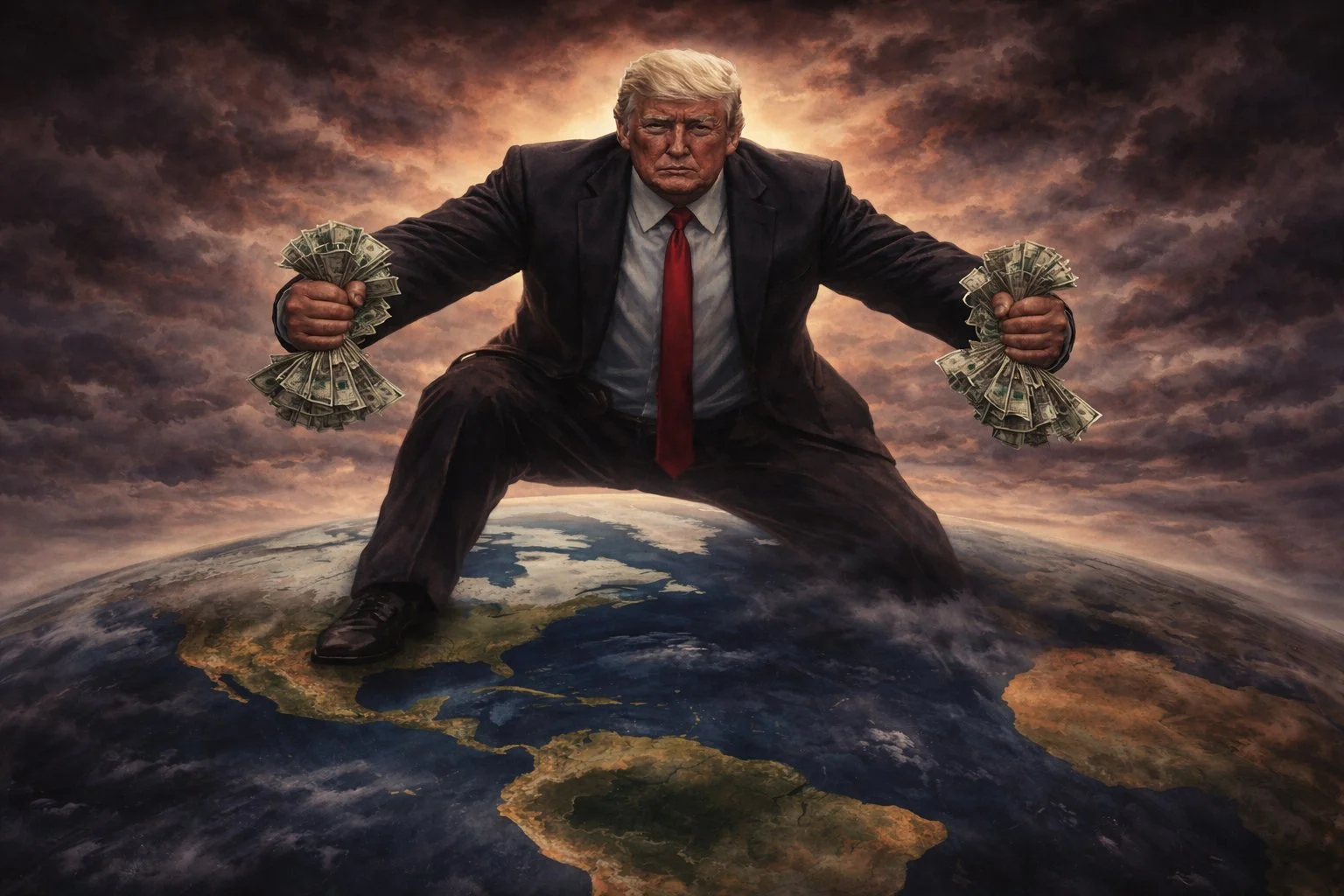
Naked Imperialism: The Trump Doctrine
The words and actions of Donald Trump reveal a man who views power as entitlement and other nations as resources to be taken.
That worldview has a name — imperialism — and history warns us what happens when it goes unchallenged.
In the past week, the former president has made his intentions explicit. Regarding Venezuela, Trump stated clearly: “We’re going to be taking out a tremendous amount of wealth out of the ground.”
Not oil leases. Not diplomatic deals. Wealth. Out of the ground. And not through partnership, but through power — power wielded by a country that sees its might as license.
This is naked aggression.
The words and actions of Donald Trump reveal a man who views power as entitlement and other nations as resources to be taken. That worldview has a name — imperialism — and history warns us what happens when it goes unchallenged.
In the past week, the former president has made his intentions explicit. Regarding Venezuela, Trump stated clearly: “We’re going to be taking out a tremendous amount of wealth out of the ground.” Not oil leases. Not diplomatic deals. Wealth. Out of the ground. And not through partnership, but through power — power wielded by a country that sees its might as license.
This is naked aggression.
It’s the same worldview behind his ongoing obsession with Greenland — a territory he has repeatedly claimed should be “part of the United States.” This week, one of his closest aides, Stephen Miller, when asked if the U.S. would rule out military force to claim Greenland, responded: “Nobody is going to fight the United States militarily over the future of Greenland.”
Let that sink in.
This is not foreign policy. It is conquest.
These are not isolated remarks or exaggerated interpretations. They are part of a deliberate pattern: a public re-embrace of raw imperial thinking — domination of land, extraction of resources, and the rejection of sovereign consent as a requirement for American action.
The response from the international community has been swift and unified. On January 6, in a rare joint statement, the leaders of France, Germany, Italy, Poland, Spain, the United Kingdom, and Denmark reminded the world — and the United States — that “Greenland belongs to its people,” and that any attempt to rewrite that fact is a violation of the most basic principles of international law. They affirmed that Denmark, and Greenland, are part of NATO — and made clear that territorial integrity, sovereignty, and the inviolability of borders are not suggestions. They are the foundation of peace.
Let’s be honest: when American presidents speak, the world listens. And when they speak like this — about taking wealth from the ground of a weakened nation, or claiming a territory populated by people who have not asked to be ruled — the world is right to be alarmed.
The Monroe Doctrine was once a warning against European colonization in the Western Hemisphere. What we are witnessing now is an inversion of that idea: the assertion that this hemisphere belongs to us, not in principle, but in possession.
We must ask ourselves: is this who we are?
Because if we remain silent while this rhetoric is normalized — if we do not call it what it is — we are complicit in its return.
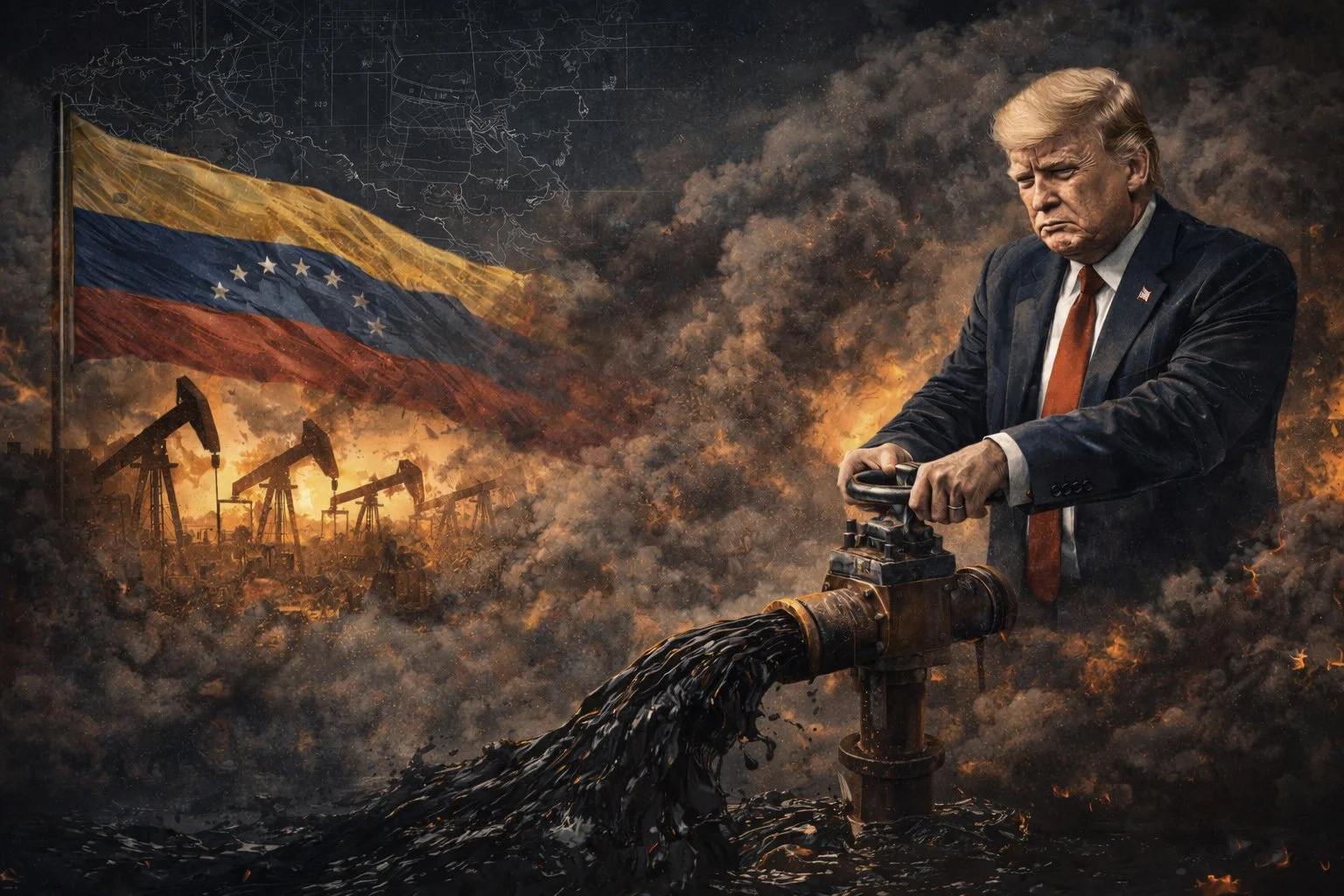
The Trump Doctrine Is About Power — and Venezuela Is Just the Beginning
This Isn’t Justice. It’s Extraction.
The Trump Doctrine Is About Power — and Venezuela Is Just the Beginning
A few hours after U.S. forces launched strikes in Venezuela and reportedly captured President Nicolás Maduro, Donald Trump stood before cameras and said the quiet part out loud.
“We’ll run Venezuela for a period of time, until there’s a transition…”
“We’ll be taking a tremendous amount of wealth out of the ground.”
It was a stunning admission — not of policy, but of purpose.
The operation wasn’t presented as regime change or liberation. It wasn’t framed as a war on terrorism or humanitarian intervention. The justification was narcotics charges. The outcome was military occupation. And the plan, according to Trump himself, involves seizing control of Venezuela’s oil and mineral reserves under the guise of transition.
If this sounds more like looting than law enforcement — it is.
And the most disturbing part is that none of it is accidental. It’s strategic. And it’s written down in black and white.
A few hours after U.S. forces launched strikes in Venezuela and reportedly captured President Nicolás Maduro, Donald Trump stood before cameras and said the quiet part out loud.
“We’ll run Venezuela for a period of time, until there’s a transition…”
“We’ll be taking a tremendous amount of wealth out of the ground.”
It was a stunning admission — not of policy, but of purpose.
The operation wasn’t presented as regime change or liberation. It wasn’t framed as a war on terrorism or a humanitarian intervention. The justification was narcotics charges.
The outcome was continued U.S. authority over Venezuela’s governance and resources. And the plan, according to Trump himself, involves seizing control of the country’s oil and mineral reserves — under the guise of transition.
If this sounds more like looting than law enforcement — it is.
And the most disturbing part is that none of it is accidental. It’s strategic. And it’s written down in black and white.
The Trump Corollary to the Monroe Doctrine
In November 2025, the Trump administration released its new National Security Strategy. It included a bold new framing of U.S. foreign policy in Latin America: a sweeping agenda called “The Trump Corollary to the Monroe Doctrine.”
This updated doctrine lays out a vision in which the entire Western Hemisphere is viewed as America’s rightful sphere of control — politically, economically, and militarily.
Here’s what it says, verbatim:
“We want a Hemisphere whose governments cooperate with us…
one that remains free of hostile foreign incursion or ownership of key assets…
that supports critical supply chains…
and ensures our continued access to key strategic locations.”
That’s not diplomacy. That’s dominance.
It continues:
“We will deny non-Hemispheric competitors the ability to own or control strategically vital assets…
We must be preeminent in the Western Hemisphere…
[so we can] assert ourselves confidently where and when we need to.”
There is no ambiguity here. The goal is to control Latin America’s resources, supply chains, ports, and politics — and to use military, diplomatic, and financial pressure to ensure that outcome.
This isn’t just about Venezuela. It’s about asserting ownership over the region itself.
Follow the Resources
The new National Security Strategy makes no secret of the real prize: natural resources.
It repeatedly highlights the need to:
“take wealth out of the ground”
secure “critical minerals and rare earth elements”
ensure U.S. access to key geographies and infrastructure
build “near-shore manufacturing” hubs to replace China as a source of cheap labor
This is not hypothetical. It’s operational.
Venezuela is the world’s largest proven oil reserve. It also has significant deposits of rare earth elements. So when the Trump administration justifies military action by citing narco-trafficking — and then immediately announces plans to “run the country” and extract its wealth — Americans have every right to ask:
Is this about justice, or about plunder?
From Security Strategy to Imperial Blueprint
What makes this moment even more dangerous is that the Trump Doctrine doesn’t just rely on raw military power — it combines it with a full-spectrum effort to reshape political regimes across Latin America.
The National Security Strategy outlines a plan to:
“enlist and expand” regional partners aligned with U.S. principles
isolate or pressure those aligned with rivals (particularly China)
control ports, infrastructure, and digital supply chains
and treat any independent economic ties as threats to U.S. security
According to reporting by journalist Ben Norton and others, this strategy has already played out through:
U.S. pressure on Panama to cancel Chinese infrastructure deals
support for the 2025 right-wing electoral takeover in Honduras
threats against Mexico, Brazil, and Colombia for working with China
and now, the use of military force in Venezuela
It is not a foreign policy. It is a corporate war plan.
The American Public Deserves to Know
None of this is about defending Maduro, or excusing Venezuela’s past failures. It’s about defending a principle: that we should not allow power — any power — to weaponize law, military force, and propaganda to hide what is ultimately a strategy of economic extraction and regime engineering.
The Trump Doctrine tells us exactly what it is: a plan to reassert U.S. dominance across Latin America, control critical resources, and block foreign competition.
“Taking wealth… while we run the country.”
Trump said exactly what this is about. And now we know, it will not stop at Venezuela.
Say the Quiet Part Loud
We are told this is justice. But Justice isn’t supposed to be a cover for looting resources.
We are told this is security. But security doesn’t begin with threats.
We are told this is leadership. But leadership doesn’t loot.
This is extraction, not liberation. And it’s time to say that out loud.

When Tribe Trumps Truth: How Identity Clouds Judgment
In a healthy democracy, disagreement is expected. People weigh evidence differently, value different outcomes, and argue their case. But something more troubling has taken hold in recent years: the growing tendency for identity to override evidence—to choose what feels loyal over what is true.
Social scientists have a name for this phenomenon. It’s often called identity-protective cognition or motivated reasoning—the tendency to process information in ways that protect one’s sense of belonging to a group. When beliefs become tied to identity, facts stop functioning as tools for understanding and start functioning as threats.
In a healthy democracy, disagreement is expected. People weigh evidence differently, value different outcomes, and argue their case. But something more troubling has taken hold in recent years: the growing tendency for identity to override evidence—to choose what feels loyal over what is true.
Social scientists have a name for this phenomenon. It’s often called identity-protective cognition or motivated reasoning—the tendency to process information in ways that protect one’s sense of belonging to a group. When beliefs become tied to identity, facts stop functioning as tools for understanding and start functioning as threats.
This isn’t a flaw unique to one political party, ideology, or faith tradition. It’s a human pattern. But in an era of fragmented media and algorithm-driven reinforcement, its consequences have become harder to ignore.
How Tribal Thinking Works
Research in social psychology shows that people are not neutral processors of information. We are more likely to accept claims that affirm our group identity and to reject or rationalize away those that challenge it—even when the evidence is strong.
Studies by researchers such as Dan Kahan at Yale have demonstrated that higher levels of education do not necessarily make people better at evaluating evidence objectively. In some cases, they make people better at defending the beliefs of their group. Intelligence becomes a tool for justification rather than correction.
This helps explain a puzzling reality: why large numbers of people sometimes support policies or leaders whose actions directly conflict with their stated values or material interests.
When Interests and Identity Collide
Consider economic policy. Over the past decade, multiple analyses by economists and government agencies have shown that broad tariffs increase consumer prices and disproportionately affect farmers, manufacturers, and working-class households. Retaliatory tariffs have repeatedly hit agricultural exports, requiring large federal subsidies to offset losses.
And yet, many voters whose livelihoods depend on affordable inputs or stable export markets have supported tariff-heavy policies because those policies were framed as symbols of national strength or group loyalty. The economic data was available. The consequences were measurable. But identity often mattered more than impact.
A similar tension appears in religious communities. Surveys consistently show that many Christians cite values such as humility, compassion for the poor, honesty, and care for the vulnerable as central to their faith. Yet political support has at times coalesced around leaders whose conduct and rhetoric openly contradict those principles.
This isn’t best explained by hypocrisy alone. It’s better understood as tribal alignment—the belief that defending “our side” is synonymous with defending what is good, even when evidence suggests otherwise.
Why Misinformation Thrives in Tribal Environments
Misinformation doesn’t spread simply because people lack access to facts. It spreads because certain claims feel right within a group’s narrative.
When identity is at stake:
Contradictory evidence is dismissed as biased or corrupt
Trusted sources are replaced with loyal ones
Correction feels like betrayal
In these conditions, truth becomes negotiable—not because people don’t care about it, but because accepting it would require social or psychological cost.
The result is a breakdown of shared reality. People no longer disagree about solutions; they disagree about basic facts. And when that happens, democratic decision-making becomes nearly impossible.
Why This Matters for Democracy
A democracy cannot function if citizens cannot agree on what is real. Shared truth is not about unanimity of opinion—it’s about having a common factual foundation on which disagreement can occur.
When tribal identity consistently overrides evidence:
Policy failures repeat without accountability
Harmful narratives go unchallenged
People vote, advocate, and argue from distorted premises
The cost isn’t abstract. It shows up in rising prices, weakened institutions, damaged communities, and people turning against one another based on fear rather than understanding.
A Question Worth Asking
None of us are immune to tribal thinking. The question isn’t whether identity shapes our beliefs—it’s whether we are willing to notice when it does.
If we all want safer communities, economic stability, and a future worth passing on, then we have to ask an uncomfortable question:
When evidence challenges what our group tells us to believe, do we lean toward truth—or toward tribe?
Rebuilding shared truth begins there.
(This piece reflects the collaborative work of The People’s Democracy).