
Truth in Crisis — Part III
Why Democracy Now Requires Constitutional Accountability
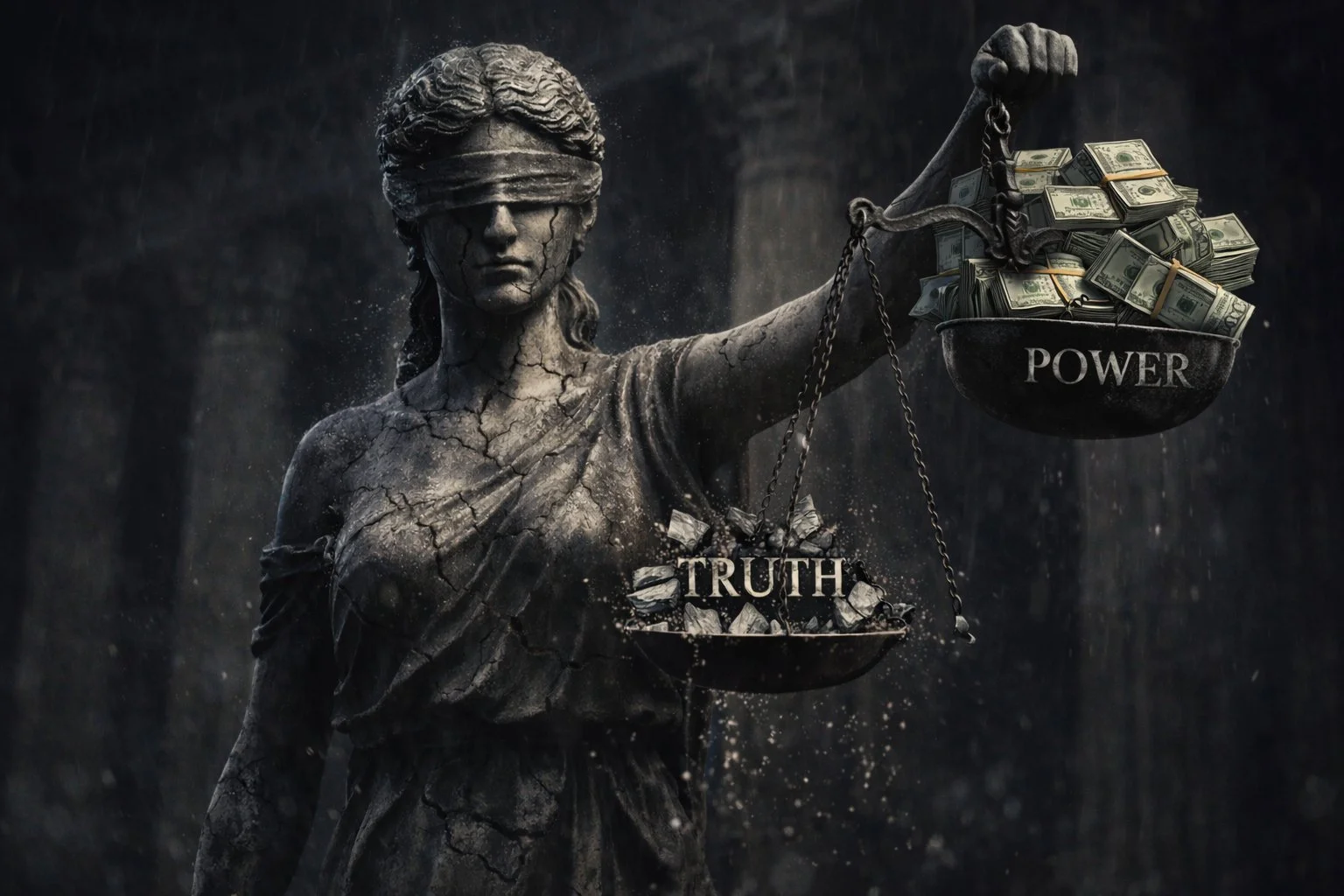
Truth shatters. Money rises. Democracy can’t survive that imbalance. It erodes—quietly, then all at once.
In Part I of this series, we examined how the First Amendment—one of the greatest achievements in democratic history—was never designed for a world of instantaneous, mass-scale information. In Part II, we explored how legal doctrines meant to protect free expression have been exploited to insulate intentional deception, allowing disinformation to spread with minimal consequence.
Together, these realities bring us to an unavoidable question:
If democracy depends on shared truth, and shared truth has collapsed, what responsibility does the Constitution have to evolve?
This is not a question about censorship. It is a question about accountability.
Free Speech and Shared Truth Are Not Opposites
Free speech is essential to democracy. It protects dissent, empowers minorities, and ensures that those in power can be challenged. But free speech alone is not sufficient for self-government.
Democracy does not require agreement.
It does require a shared factual baseline.
Citizens cannot deliberate, vote, or hold leaders accountable if reality itself is fragmented—if facts are optional, lies are profitable, and deception carries no consequence. In such an environment, speech remains free, but democracy becomes hollow.
This is the condition we now face.
What This Is Not About
Any discussion of constitutional reform must begin by drawing clear boundaries.
This is not about:
Banning opinion
Criminalizing dissent
Government control of ideas
Punishing honest mistakes or good-faith reporting
Opinion deserves protection. Advocacy deserves protection. Political speech deserves protection.
What does not deserve protection is intentional, knowing deception presented as truth to mass audiences under the authority of journalism.
That distinction is not radical. It is foundational.
Intent Matters
Every functioning legal system recognizes intent. Fraud law, consumer protection law, and civil liability all hinge on whether deception was knowing and deliberate.
The same principle must apply to modern information power.
There is a fundamental difference between:
Being wrong
Being misleading
Being mistaken in real time
And:
Knowingly spreading false factual claims
Repeating those claims after they have been disproven
Continuing to profit from deception while denying accountability
Democracy cannot survive if those behaviors are treated as cost-free.
Power Requires Responsibility
The framers assumed speech power was diffuse. They did not anticipate a handful of institutions reaching tens of millions of people daily, shaping political identity, public trust, and electoral outcomes.
In every other domain of democratic life, power carries obligation:
Financial institutions are regulated
Advertising is subject to truth-in-representation standards
Public companies must disclose material facts
Only mass media—despite its enormous influence—operates without comparable responsibility.
This is not a defense of regulation for its own sake. It is a recognition that unaccountable power corrodes democracy, no matter its form.
What Constitutional Accountability Could Look Like
Any constitutional evolution must be narrow, principled, and precise. The goal is not control—it is integrity.
At minimum, reform must address three principles:
1. Truth in Representation
If an outlet presents itself as “news,” uses journalistic authority, and reaches mass audiences, it must be legally obligated to distinguish fact from opinion and correct known falsehoods.
2. Consequences for Intentional Deception
When false factual claims are knowingly spread and repeated, consequences must be proportional to the harm caused—civil, not criminal, and adjudicated through courts, not political bodies.
3. Protection for Good-Faith Speech
Any reform must explicitly protect dissent, advocacy, satire, and honest reporting, ensuring that accountability applies only to deliberate deception, not disagreement.
These are not censorship tools. They are democratic safeguards.
Why This Cannot Wait
History shows that democracies rarely collapse overnight. They erode gradually—when trust disappears, when truth fragments, and when citizens no longer believe their institutions operate in good faith.
The United States is not immune.
When lies become loyalty tests, when outrage replaces deliberation, and when reality itself is contested, democratic self-government becomes impossible—even if elections continue.
Free speech protects voices.
Democracy requires truth.
The Constitution has been amended before to correct unintended consequences, expand rights, and meet the demands of a changing society. Treating the First Amendment as untouchable doctrine rather than a living framework does not honor the framers—it freezes democracy in a world that no longer exists.
The question is no longer whether reform is controversial.
The question is whether democracy can survive without it.
Shared truth is not a luxury.
It is a requirement.