
Truth in Crisis — Part II
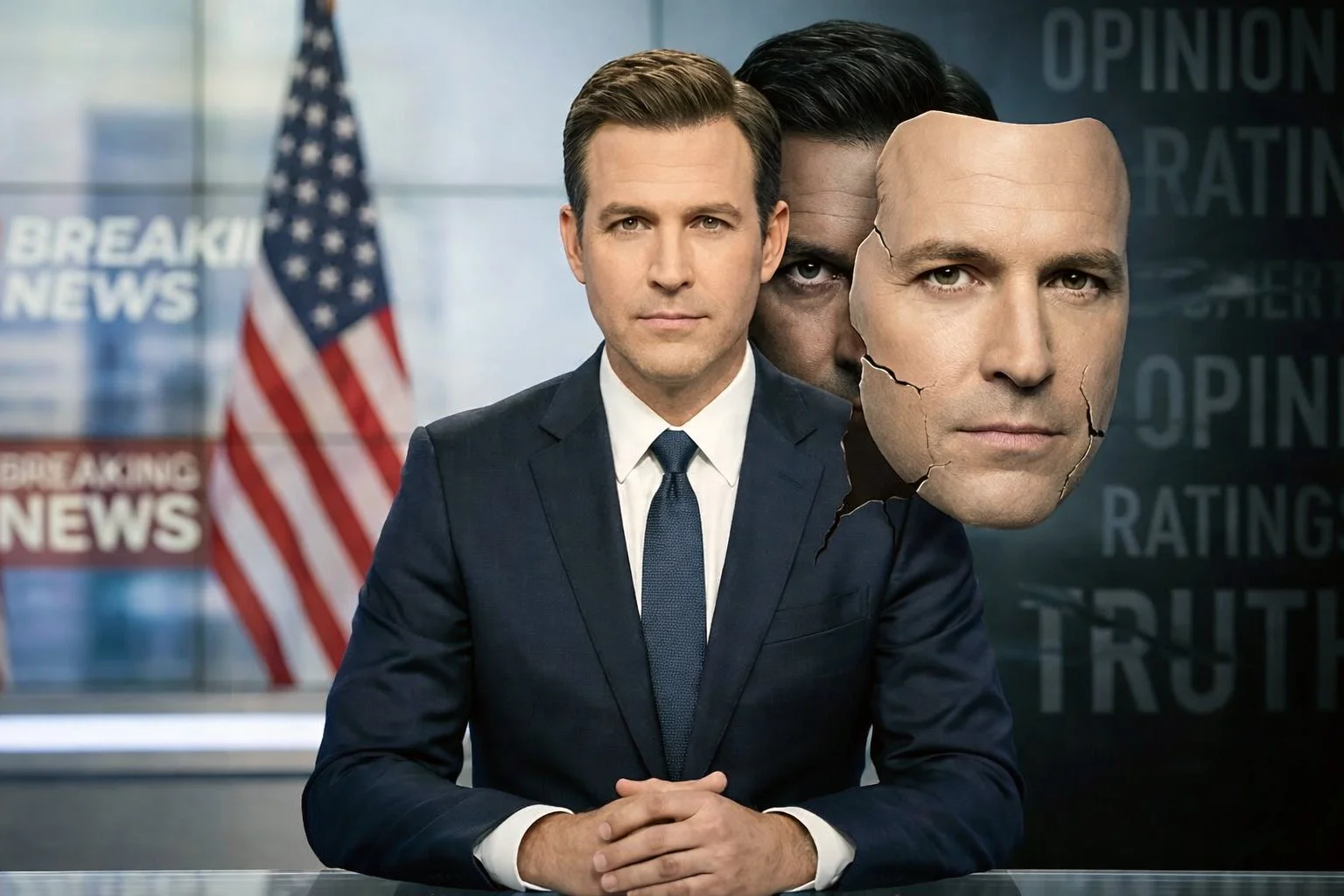
Behind the studio lights: power, profit, and a manufactured reality. They don’t inform you. They engineer you.
How Disinformation Became Legally Untouchable
In Part I of this series, we explored how the First Amendment—written for pamphlets and printing presses—has struggled to govern a modern information ecosystem defined by speed, scale, and profit. That mismatch created a dangerous gap: while speech is protected from government suppression, the public is left largely unprotected from intentional deception.
That gap did not emerge by accident. It has been exploited—methodically, legally, and profitably.
Today, some of the most damaging falsehoods in American public life are not spread in spite of the law, but because of how the law is structured. Over time, powerful media organizations and online personalities have learned how to operate within the letter of the First Amendment while undermining the democratic purpose it was meant to serve.
Four legal and structural shields make this possible.
1. Opinion as a Legal Shield
The most significant protection for modern disinformation is the legal distinction between fact and opinion.
Courts give wide latitude to opinion, recognizing that democratic debate requires room for interpretation, advocacy, and even provocation. That protection is essential. But it has been weaponized.
Today, opinion programming often adopts the full visual and rhetorical language of journalism—news desks, breaking banners, authoritative tone—while delivering false factual claims. When challenged, these same programs retreat behind the claim that they are merely offering opinion or entertainment, and that no reasonable viewer should interpret their statements as literal fact.
This creates a shell game.
Viewers are encouraged to treat the content as news. Courts are asked to treat it as performance. The result is a system in which factual falsehoods can be broadcast nightly to millions, so long as they are wrapped in opinion framing.
Opinion deserves protection.
Disinformation does not.
2. The “Actual Malice” Barrier
Even when false statements cause demonstrable harm, legal accountability is extraordinarily difficult to achieve.
Under long-standing Supreme Court precedent, public figures seeking to prove defamation must demonstrate “actual malice”—that a statement was false and that the speaker knew it was false or acted with reckless disregard for the truth.
This standard was established to protect a free press from intimidation and censorship. But in the modern media environment, it has become an almost insurmountable barrier.
Proving actual malice requires access to internal communications, editorial deliberations, and private acknowledgments—materials that are rarely available without years of litigation and immense financial resources. As a result, most cases fail long before reaching trial.
Accountability becomes the exception, not the rule.
3. No Truth-in-News Requirement
Contrary to popular belief, there is no general legal requirement in the United States that news outlets be truthful.
The Federal Communications Commission does not regulate cable news content. The Fairness Doctrine no longer exists. There is no federal “truth in reporting” standard comparable to consumer protection laws that govern advertising or financial disclosures.
Enforcement is almost entirely civil, not regulatory. That means accountability depends on private lawsuits—slow, expensive, and often inaccessible to ordinary citizens.
In practice, this creates a vacuum: a system where the most powerful voices face the fewest consequences.
4. Money, Power, and Delay
Even when lies cross legal thresholds, the realities of wealth and time intervene.
Litigation takes years. Legal teams cost millions. Most individuals, journalists, and organizations cannot afford to pursue justice through the courts. By the time a case is resolved—if it ever is—the damage to public trust, democratic norms, and civic cohesion has already been done.
Rare exceptions prove the rule. Only entities with extraordinary resources and access to internal evidence have been able to break through this wall. Those cases are not signs of a healthy system—they are signs of how broken it has become.
What This System Produces
Together, these four shields create a predictable outcome:
False factual claims spread widely
Corrections arrive late, if at all
Accountability is rare
Trust erodes
Anger replaces deliberation
This is not an accident. It is the logical consequence of a legal framework that protects speech without accounting for power, reach, or intent.
The First Amendment does not grant the right to lie.
But it has created a system in which powerful media organizations can spread disinformation with minimal accountability.
That distinction matters.
Democracy depends not on agreement, but on a shared factual baseline. When that baseline collapses—when opinion becomes a delivery system for lies—self-government becomes impossible.
This is not a call to suppress speech. It is a call to confront a reality we can no longer afford to ignore.
If intentional deception carries no consequence, democracy cannot survive.
Part III will examine why restoring shared truth now requires constitutional accountability—and what reform could look like without threatening free expression.